Transcript:
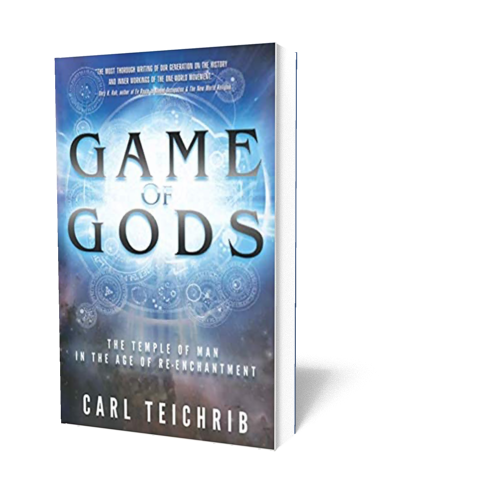
Tom: Welcome to Apostasy Update. I’m T. A. McMahon, and in this program we’re addressing biblical eschatology—what the Bible has to say prophetically about the last days prior to the return of Jesus Christ. My partner in this discussion is Carl Teichrib. He’s the author of Game of Gods: The Temple of Man in the Age of Re-enchantment.
Carl, welcome back, and thanks for joining me in our ongoing discussions on where the world and Christendom are headed according to the Scriptures as history draws to a close.
Carl: It’s good to be back, Tom. What a day, what an age to be alive.
Tom: Amen. You know, much of the information we’ve been presenting in this series is taken from four books: your book, Carl, Game of Gods; America, the Sorcerer’s New Apprentice; Christianity and Anti-Christianity in Their Final Conflict; and most importantly, the Bible, which is God’s direct communication to mankind.
We’re now focusing on Carl Teichrib’s book Game of Gods: The Temple of Man in the Age of Re-enchantment.And, Carl, in this program, I’d like to discuss socialism, which you address particularly in chapter 4 of your book. And one of the reasons for talking about socialism is we are recording this on our election day here in the United States, and if we elect a Democratic president and his party’s platform, it will be a major stride in moving our country toward socialism.
So, Carl, give us a definition of socialism and some of its features and problems when it’s been implemented throughout the world.
Carl: Socialism is an idea that’s been around, Tom, for a very long time. And to bring 100 years of socialist thought—realistically more than 100 years of socialist thought—into a half-hour conversation is staggering to think about! How can we achieve this? We can’t. But what we can do is…
Tom: And depressing, by the way!
Carl: And it’s so true!
Tom: We’re going to get past that.
Carl: That is so true! What’s interesting—and really, again, the depressing side is to have this conversation now tells me that we haven’t learned the lessons of the last 150 years. And regardless of the outcome of today’s election (because of course, as you made note, we’re talking about this on your election day), the very notion that this is still being discussed, that this is still a platform, a worldview, an ideology that has such a grip demonstrates that it’s important we tackle this subject. It’s important that we look into the history of it.
What socialism ultimately is, Tom, is the planned society. It’s about man planning his future, planning a utopian…or planning an ideal civilization, not giving the free market or individuals the chance to blunder it and blunder our way forward. Rather, we can achieve what we hope to be the benefits of a planned society now. And what makes socialism so appealing is it says, “Look, culture and civilization does have pressing issues. There are problems, there are needs, there is poverty, there are health concerns. The list goes on and on, and we can leapfrog the free market if we just all come together as one and plan this, and then work as one towards achieving that goal.” It is communal in its thinking. Socialism’s history is rife with bloody utopian outcomes. It is a utopian dream, but it ends up becoming a bloody utopian nightmare.
Now, it’s also important for your listeners to understand that there are variations of socialism. There are a number of different models of how socialism works. But socialism is always, “We will plan our way forward, and we will plan it with the understanding,” the spiritual, theological worldview understanding, that really it says, “Man can direct his own future. Man is the one in charge of putting purpose and meaning in place. We will do this collectively.”
It’s a shadow of the Tower of Babel in many respects. And as you go through the history of socialism as an idea and as a movement, you run into so many points within the literature that makes reference to the…that this is a type of salvation action. We’re saving ourselves.
Tom, you are just an atom; you are just a component. I am just an atom. I’m just a piece of the bigger machinery of our collective salvation, our collective society. That’s what socialism ultimately moves us towards is…it is a collective. So you don’t count so much, Tom, as an individual unless you find your purpose and meaning in the whole, in the collective. It takes away man’s image (made in Genesis as a reflection of God’s image) and says, “Now we will make man in our image, in the image of our collective.”
Tom: Mm-hmm.
Carl: So it’s profound. I can’t believe it’s still here—and yes, of course I still believe it’s here, because, I mean, it’s a part of your nation’s democratic platform right now. The socialist impulse is there. I live in Canada, and socialism is alive and well.
And, Tom, if we are honest, both in your country and in my country, we live in what we considered a mixed system. There are elements of socialism and capitalism. There are elements of planning and collectivism, and elements of individualism and the allowance of free market movement. The two of them are always, though, in collision, and there’s always this battle within our culture over “which way forward?” More collectivism or more freedom, more personal responsibility? Which way do we go? I get the appeal too of socialism in that it takes away my personal responsibility…
Tom: Mm-hmm.
Carl: …and it puts it in the hands of the state, or the hands of, really, the bureaucrat.
Tom: Right. Carl, I’ve got a quote from your book. The point that will come through here very clearly is socialism has a demolition mentality. Vladimir Lenin, quoting him, “Yes, we are going to destroy everything, and on the ruins we will build our temple.” This is your “temple of man…”
Carl: Exactly.
Tom: …the title for it. So, what about that? Is there history enough to back up Lenin’s quote?
Carl: There’s more than ample history. Tom, more lives have been lost under socialist, communist, totalitarian, “utopian” regimes in the last 100 years than lost in warfare. Solider against soldier versus what a government will do to its own people.
There’s a professor (his name is R. J. Rummel) who did statistical analysis looking at the cost of war in the last 100 (now plus) years. And as he was working through the statistical analysis, what struck him was there was a great number of lives that were missing in terms of looking at the death count. Soldier to soldier, which is what warfare is supposed to be—it’s not supposed to be soldier against civilization or against citizens, but warfare classically is solider against solider—accounted for roughly 50 million or so, maybe more, battle-dead in the last 100 years, which is horrific!
But—but—governments, particularly socialist, authoritarian, communist governments have slaughtered roughly 200 million lives in “peace” over the last 100 years. And Rummel makes the argument it’s almost as if we had a nuclear war that went on without dropping bombs on each other. It was government doing it, socialist government, communist, collectivist governments doing this against its own people.
Because in a socialist, communist system, you can’t have any leaf that sticks up above the hedge. It has to be a nice, neat, clean cut. And don’t you dare have an idea or threaten the power of the state, because they have a messianic impulse—they know the way forward. They’re saving—they are saving civilization by creating their own utopia on earth now. It is the idea of building a kingdom of heaven here and now, and it has had disastrous results, utterly, utterly disastrous.
And also…and this is very important for people to understand, because I’ve been hearing the left-right talk within your own national fabric, a lot of talk, and even—I mean, I’ve heard it on social media, I’ve heard it in different places—how the Republican, Trump, the right wing is more in tune with the idea of right-wing authoritarianism. And they always throw out the concept of national socialism, Nazi Germany. Sorry! Sorry! If you actually unpack Nazi Germany, it was not right wing. Nazi Germany had a socialist planned system. It was completely built along those precepts. It had more in kind with its kissing cousin communism than it does with anything that we can think of in terms of right wing now.
It’s important, Tom, that we—we kind of set a definition in place, what right or left is, because that’s part of this conversation. I make the claim right in the very beginning of the book—I think it’s in my introduction—that the right (and I’m using this definition, because otherwise we get confused), to be on the right, means maximum personal responsibility, minimum government responsibility or government power. On the far left, minimum personal responsibility, maximum government power. When you take a look at it from that perspective—and by the way, that’s how the progressive left was viewing it in the 1920s and ‘30s—then you realize, oh, okay, you can claim right-wing authoritarianism, but it really is ultimately a socialist construct, because it’s saying authoritarianism, it’s the power of the state, the power of the bureaucrat, the power of our collective, not looking for any way forward outside of some collective action.
Tom: Mm-hmm.
Carl: So socialism has great appeal, but its execution inevitably becomes deadly and damaging. And I know some people will say, “Well, you know, we just haven’t done it right yet! We haven’t…we just didn’t do it the right way.” Well, tell me, how many ways can we try this? It’s been tried in so many different fashions and so many different ways!
And even in our mixed economy, where we have both socialism and free market, you know, in your country and in my country, even if it doesn’t go down the road of authoritarianism, socialism still degrades, because what it does is it has to build a bureaucracy. It has to build up more systems of management, and it always becomes top heavy.
My country Canada has a socialized medicine, a socialized Medicare system, and it’s universal. We have universal health. There are some benefits. I can go to the hospital and I can be treated without having to worry about paying a bill. I pay the bill, though, every year in my taxes! Unbelievable amount of taxes! We all do, and it gets…and the bureaucracy and the bloat around it gets bigger and bigger and more burdensome, and to the point where… In my country, our healthcare system, while there are benefits to it, I personally—my own family, my own mother, who’s now gone—can attest that the bloat, and the bureaucracy, and the management, and mismanagement, and the size of the machine that it becomes strips away those benefits in time. It still helps people, yes, and lots of people still fall through the cracks, yes.
Tom: So, Carl, now, a couple of things, as you’ve been talking, that I think about: as you point out, it’s never worked. It hasn’t worked. Show me a pocket. Yes, there are some benefits, but the benefits certainly, as you’ve described, don’t outweigh the problems.
But one of the things that you said earlier that I think you put the stamp on it—I’ve heard, and I’m sure other people have heard, “Well, if we could just get rid of religion, okay, we would end all wars.” Did religion have anything to do with what you’ve described?
Carl: No.
Tom: Okay. So let me take this a little further: In many of the quotes from your book that we could use, Christianity was and is the first to go, okay? We could quote another Lennon on that, as in John Lennon, okay? “Imagine there’s no heaven, it’s easy if you try.” And then later, “I hope someday you’ll join us, and the world will be as one.” That’s underscoring, putting to music, you know, the issue and things that we’re concerned about here.
It’s happened through the hundred years…we could go to, you know, the French Revolution, start with that, and then we can see, no, religion is the problem, according to the socialists.
Carl: Absolutely it’s the problem. I’m just going to look for a quote here, because there’s enough quotes that we could pull from to demonstrate…I think one from Julian Huxley kind of fits. Julian Huxley…
Tom: Who is he? Isn’t he the grandson of…
Carl: Yes! Thomas Huxley, Darwin’s “bulldog!”
Tom: Right.
Carl: Yeah!
Tom: Okay, so I’m just pointing out a connection there, not just interrupting.
Carl: Oh, yeah! And Julian Huxley was all about creating a “religion without revelation.” That was the language he used, understanding that we’re moving towards oneness of all, that we’re moving towards some mystical—secular mystical—oneness. This is what he writes in his book Religion Without Revelation:
“It is obvious that any religion which lays primary emphasis on salvation in the next world will be something of an obstacle towards getting the best out of this world as speedily as possible. Once we have rid ourselves of this doctrine of a divine power external to ourselves, we can get busy with the real task of dealing with our inner forces.”
That says it, pretty much!
Tom: Yeah, didn’t that happen in the Soviet Union? Didn’t that—didn’t they get rid of religion and it…supposedly?
Carl: Ha! That’s right! And then when you go back into the history of socialist thinking and you end up running into Saint-Simon and Auguste Comte, two French philosophers who came about after the French Revolution.
Now, Saint-Simon and Auguste Comte are the fathers of social studies, of sociology, and really the fathers of socialism. And both of them understood that Christianity stood in the way of having these positive collective feelings and this positive utopian social good. So this is what—this is what Saint-Simon explains in terms of the problem of worship and Christianity. He said this: “The study of the Bible draws attention to political motives contrary to the public welfare. It prevents the Protestants from working for a political system in which common interest will be managed by the ableist men in science, art, and industry.”
Quit studying your Bible, Tom! Quit going to church, Tom, because it’s taking away your political motive to work as a collective for the common good, for the common interest!
Tom: Right.
Carl: They understood that this was a competition of sorts, that there was—they were both making claims that the Bible is making claims that our salvation comes from God and that Jesus Christ is the one who builds the kingdom. But no, that’s the competition, because they’re saying they’re the ones who save, and our kingdom is here in the collective.
Tom: You know, Carl, I…there are so many things, as you said, we could talk about in this. But the question is, for all those who are flocking to this, who are excited about it—for some of the benefits, okay, we’re not denying that—but the issue is, Carl, who’s calling the shots here? Who’s in charge? Is it you, me? Is it…you talked about we’re just a cell, we’re just an atom in this whole program. Do we have any say in this? And who’s—who’s making…you know, again, you could go back to the “plan.” You’ve mentioned this before—they always have a plan. Who’s in charge of the plan? Who’s running the plan?
And you mentioned earlier before we started having this conversation that all of this is connected. You could go from, you know, the French Revolution to Marx to Lenin to Mao—I mean, it’s all interacted and connected. You could go to Cuba, you know, Che and Castro and so on. But I want to know, since I have to—if I want to jump on board with this, I want to know who’s calling the shots!
Carl: I’m not calling the shots! You’re not calling the shots! [unintelligible]
Tom: You know, folks, we’re laughing, but we’re crying on the inside, because this is so ludicrous! This is so ridiculous!
Carl: I know! And I guarantee you the social justice warriors who are in the street, emotionally pulled into this, because the power of emotion—we need to bring that up…
Tom: Okay.
Carl: …is a very, very powerful, powerful component. They’re not leading this either. No, so much of this pulls from the world of left academia, especially left academia; from progressive left political platforms; progressive left political action groups… It’s never going away, and that’s the thing that people need to keep in mind. This is a worldview that, while the faces may change, the ideas don’t. While we may not have the “Communist Party of the United States” having the political, kinda, pressure [unintelligible] the communist party did in other parts of the world, you still have the thrust of this idea, the thrust of socialism. And yes, in your country you do have socialist political parties, and you do have a communist political party, but they’re almost as if they’re, you know, they’re kind of off to the side, because the idea has already rooted itself in the culture deep enough that it has already taken shape.
Tom: Carl, earlier…just let me throw this in: back to my question “who’s calling the shots,” earlier in your book you’re talking about, well, it’s got to be the scientists, you know, and then you go down the line. It’s got to be those who are, you know, already making…basically capitalism, making money! Those with the wealth, okay? So it goes down to the line—well, where am I in it? Where are you in this? And who elected these guys? Wait a minute, they weren’t elected, you know. That’s not an issue, even though we have some of that today. But if it continues, if it grows, forget election. I mean, that’s going to go by the board so fast.
Anyway, so…
Carl: And I’m glad you brought that up. Can I add one more position to those positions you just described, scientists and so on? Theologians, theologians.
Listen, when I was—this is back in 2010. This is a little bit of a rabbit trail. I went to the G8/G20 World Religion Summit that took place in Winnipeg. It was all about trying to find some international way forward, all coming together with a plan at the global level, okay? Because interfaithism ultimately becomes political, always does. And this particular gathering was made up mostly of Christian representatives, all right, including evangelical representatives. And over and over again, we were told how we all need to come together. And ultimately what they were describing was a form of international socialism to say, “We need to empower the United Nations. We need to create literally a type of kingdom of heaven on earth now, and we need to do this at a planetary level.”
I remember the Salvation Army representative talking about how it’s not about having one bike per person, using the bicycle as an analogy—no, no, no, no, no! That’s free market, that’s capitalism. No, it’s about having one bike in community and learning to share. Really? We’ve tried this; we’ve tried this. Why is it that—I’m looking right now within the world of Christendom—why are we so pulled by this idea? That somehow we, we, if we just plan this out, we could create this utopia on earth. I don’t get it! I don’t get it, Tom, because the history of mankind demonstrates otherwise. Man can’t save himself. We need Jesus Christ.
Tom: You know, Carl, through all the discussions we have had, and I’ll tell you, I’ve learned a lot from you, buddy! I’m really thankful. And…but there’s something that never—it’s never mentioned. I’m not talking about by us, although, you know, we probably should have brought this forth a little bit more in the context of what we’re talking about, and that is in all the attempts by man to make the world a better place, there’s been no hint that man, even some men, are evil! You would think that might be a flaw in trying to, and… [unintelligible] even in the religious group and so on.
Oh, and by the way, folks, when we’re talking about Christianity, certainly—and Carl mentioned evangelical Christianity—when we’re talking about Christianity in a way that has meaning and truth and all that, it’s called biblical Christianity. That’s what separates. You can call yourself a Christian, you know, as a Jehovah’s Witness or a Mormon or whoever. No. Or even, you know, some of the movements that might be considered—yeah, well, this is really evangelical Christianity.
For example, we’ve been talking about mysticism. What about the whole contemplative movement? That’s Eastern mysticism in a, you know, in the language that sounds like it’s biblical, which it isn’t. So the point being here that…biblical Christianity, and it talks about the heart of man: “The heart is deceitful above all things and desperately wicked. Who can know it?” Only God knows the heart, and He knows our makeup. He knows what we’re about, especially before we come to Him and are transformed by His saving grace, by salvation of what Christ accomplished for us on the cross.
So anyway, I just think, Well, hold a minute, folks, I think we’ve got some bad guys out there!
Now, what’s interesting, going back to the revolutions, okay, it wasn’t the bad guys that are killed, okay, that are destroyed. It was those who stood for biblical Christianity, right?
Carl: Yes. And also, the left—socialism tends to eat its own, as well, because it becomes untrustworthy of its own, you know, its own circles, its own cog tray.
I think the area of emotion and the power of the emotional appeal has to be addressed. Allow me to read a quote from Benjamin Kidd who understood that socialism and this idea of the collective was where civilization was moving. Now this is from 1919: “The great secret of the coming age of the world is that civilization rests not on reason, but on emotion.” Then he continues: “It is clearly in evidence of the science of creating and transmitting public opinion under the influence of collective emotion is about to become the principle science of civilization to the mastery of which all governments and all powerful interests will in the future address themselves with every resource at their command.”
Absolutely. Absolutely. When you see the raw emotion on the street, when you see the anger, when you see that righteous indignation, fist pumping, it is raw, it is emotional, it is powerful. Lenin understood that. Stalin understood that. I don’t…Hitler understood that power. In fact…
Tom: Absolutely.
Carl: …in that chapter, the section I just read from Benjamin Kidd, the next couple of sections deals on how in Nazi Germany, the power of the emotion, the strength of that emotional pull, played such an important role in saying, “We all need to come together as the collective man, no longer the individual man.” Under national socialism, German national socialism, we built around a German ideal, a German sense of mystical union, whereas international socialism, communism, was around the idea of “workers of the world unite.”
Tom: Well, Carl, let’s go back. I mean, again, you know, it’s been wonderful. We’ve had close to 20 discussions about this, but let’s go back. Robert Mueller, for example, excited about children, okay? And Kidd, as I remember it, the quote from Kidd was, “Hey, the young people, they’re emotionally driven,” something to that effect. But let’s take it down the line: why do you have to move into emotions? Why do you have to move into the subjective aspects of it? Well, we could sing—I don’t want to sing it, but John Lennon’s song—just imagine! If it’s not working, if it hasn’t worked and so on, we’ve got to move up into this realm of the imagination. That’s why the scripture says, “Casting down the imagination and everything that exalts itself against the knowledge of God. Let every thought be taken captive in Christ.”
So that’s truth! That’s absolute truth. But when it’s not working and it’s not working, we’ve got to keep pumping it up, we’ve got to keep making it go forward—not we, but certainly those who are in charge. That’s what they want to do. But…
Carl: Because—and this is important, Tom—because it energizes the ideal! It isn’t just simply now a slogan or an academic exercise. It energizes it. It gives them motive.
Tom: Yeah.
Carl: And then they become true disciples.
Tom: Yeah. And, Carl, why doesn’t that fall off the rails? Because it hasn’t worked! It’s never worked. It’s created destruction that’s, as you said, wars with soldiers, you know, doesn’t even come close to the deaths and destruction from these regimes that have promoted this and so on.
You would think, Hey, wait a minute…Well, you said it before we went on about, What about man’s memory?What about…don’t just go back 2000 years, just go back a hundred years and check out what’s taken place.
Carl: Right.
Tom: It’s amazing, stunning, grievous…
Carl: Allow me to read this. Yeah, it is grievous, absolutely! Allow me to read—I’m going to read a couple small sections. I don’t know how much time we have, Tom, but…
Tom: Well, we’ve got about three minutes.
Carl: Okay, okay. This is what…and you can find this on page [54], “Journalist Robert Keyserlingk witnessed the consequences of such revolutionary thinking. While in Berlin, 1930, he watched in astonishment as several hundred young men and young women were being confirmed into the socialist faith. This, Keyserlingk noted, was indicative of the spiritual vacuum created in the West by its exclusive rejection of Christian principles.” And this is what Keyserlingk has to say: “Having negated personal creation, and therefore individual salvation, but finding it impossible to live as a senseless atom in a cruel world, man filled the spiritual vacuum by the ideal of primitive mankind, the group worship of itself.”
Tom, I think he nailed it. That’s socialism. It is the group worship of itself. It is another form, or an alternative form, of salvation, where man says, “We save ourselves.”
Tom: Yeah. Carl, just in the last minute or so, this issue of rejecting God, the God of the Bible, the Creator of the universe—in rejecting that, there had to be an option that they thought could work, or that might work. It hasn’t, and it can’t happen, and so on, I mean, according to the Scriptures. So the question is, how does this fit in, socialism—just one last thought here—how does socialism fit in that we’re all God, that we’re all… You know, is there a relationship between that and the idea of pantheism, which we’ve been talking about?
Carl: Mm-hmm, absolutely there is, and it fits this way: we are divine in our collective. We are messianic in our collective. It’s not now becoming you or me individually as divine, it is our divinity is found within the group. And the group then gives us our identity. To me, Tom, that is extremely dangerous. Extremely dangerous. It is setting up a false god, and that false god is not the individual, but humanity itself.
Tom: Yeah. Okay, brother, once again, I learned a lot from you, and I’m really thankful. So it’s just been a pleasure. And even though this is hard stuff, this is stuff that…you know, about all we can say, however things turn out—as I said, we’re airing this sometime after the election. But nevertheless, we’re clinging—we’re going to cling to Jesus, no matter what happens, you know. He knows. He is the one that’s in charge. He’s allowing certain things to happen, and He’s not taking responsibility for it, it’s on those and how they’ve responded to what’s been before them. But we’re going to do it with Him by the grace of God and by His enablement, by His Holy Spirit. Okay?
Carl: Absolutely.
Tom: Okay, thanks, Carl.
Carl: All right, bye-bye.