Saturday, June 11, 2016

ARE THEY GOSSIPING ABOUT YOU? Greg Laurie from wnd.com


After they had spent some time together, one pastor began to bare his heart. He shared his struggles, his problems and evenly specifically confessed sins that he was grappling with at that time. He encouraged the other two pastors to do the same. The second pastor followed suit, and he, too, disclosed intimate information about his own life. The third pastor wasn’t saying much, so the other two encouraged him to bare his heart and share what he struggled with.
“Well,” he told them, “I wasn’t going to say anything. But the sin I really struggle with is the sin of gossip. I can’t wait to get home.”
If we were to name the 10 worst sins we could think of, I don’t know how many of us would put gossip on that list. But when God identified seven of the things he hates, he included by implication the sin of gossip, or misusing our words. Proverbs 6 tells us, “There are six things the Lord hates, seven that are detestable to him: haughty eyes, a lying tongue, hands that shed innocent blood, a heart that devises wicked schemes, feet that are quick to rush into evil, a false witness who pours out lies and a person who stirs up conflict in the community” (verses 16–19 NIV).
At one time or another, all of us have felt the bitter sting of gossip in our lives. Maybe someone told a lie about you or passed a story on about you that simply wasn’t true.
In Psalm 140, David lamented over those who had gossiped about him, who had lied about his character. It obviously was a source of great pain to him. He started off by saying, “Rescue me, Lord, from evildoers; protect me from the violent, who devise evil plans in their hearts and stir up war every day” (verses 1–2 NIV).
We are living in a wicked, vicious time. It seems as though people today have an unhealthy appetite for gossip. We call this a tabloid mentality, and we now see this type of thinking and reporting almost across the board in journalism. When we turn on the evening news, we see things that have nothing to do with the news, things that have a gossipy feel to them.
As a culture, we want to know the inside scoop. We want to hear the dirt on this person or that person. There is something in our nature that wants to know more and more.
Then there are the talk shows and the so-called reality shows. When you think you have seen and heard it all, you see something worse. It seems like these things are snowballing in our culture, getting lower and lower. We are living in a wicked world, a violent world.
David was saying, “Deliver me from people like this, Lord.” He was facing a carefully planned campaign of slander and lies.
You have heard the adage “Good news travels fast,” but I would add that bad news travels faster. It’s been said that a lie is halfway around the world while truth is still putting on its shoes. There is something about a falsehood that just spreads like a wildfire.
David went on to say, “The arrogant have hidden a snare for me; they have spread out the cords of their net and have set traps for me along my path” (verse 5 NIV). His enemies literally were lying in wait for him, setting up a custom trap designed to snare him.
Quite honestly, there will be people who just don’t like you a whole lot. It’s hard to deal with that, because maybe you are an outgoing, friendly person who likes to get along with everyone. When you sense hostility or resentment from people, you wonder, “What did I ever do to them?”
They watch you. They scrutinize you. They want to find something in your life they would perceive as being inconsistent, because then they can say, “Aha! That individual is a hypocrite. Therefore, I don’t have to be concerned with what that person says.”
You can go crazy trying to figure these things out and trying to defend yourself at every turn. So what do you do? I like the words of the great evangelist Dwight L. Moody, who said, “If I take care of my character, God will take care of my reputation.”
The main thing we should concentrate on is trying to be that good example. And when we fall short (and we will), we should be honest enough to admit it.
What did David do with his concern? He cast it upon the Lord. In verses 6–7 he says, “I say to the Lord, ‘You are my God.’ Hear, Lord, my cry for mercy. Sovereign Lord, my strong deliverer, you shield my head in the day of battle.” (NIV)
David was saying, “Lord, I place it on you.” It’s great to know that we have a God we can cast our burdens on.
Are you burdened today? Is something troubling you? Do you have anxiety over some situation? Maybe it’s a problem at work. Maybe it’s a problem with your husband or wife. Maybe it’s your children or your parents. Whatever it is, you’re carrying a burden today and don’t know what to do with it. David gave us an example. Cast it on the Lord.
Jesus said, “Come to me, all you who are weary and burdened, and I will give you rest” (Matthew 11:28 NIV).
We’re also told in the book of 1 Peter, “Cast all your anxiety on him because he cares for you” (5:7 NIV).
What would you think if someone knocked on your door and said, “I live in the neighborhood. I actually like to take trash out. It is my delight to do it. Will you please give me the opportunity to go through your house, empty every wastebasket, clean up any messes you have, and take your trash away from you?”
That is what God is essentially saying to us. He’s saying, “Will you bring your problems to me? Will you bring your burdens to me? Let me take them from you.”


Evidence of a Catastrophic Flood in Antarctica? Ken Ham From Answers in Genesis answersingenesis.org


?

by Ken Ham on 
For years, most scientists thought that Antarctic creatures were safe from the supposed dinosaur extinction event. But new researchsuggests that the alleged catastrophe thought to be responsible for wiping out dinosaurs also affected those in the far south. But what was this global catastrophe? Was it an asteroid impact millions of years ago or a watery judgment by God on a wicked world?
The Flood

A “Sudden and Catastrophic Event”

Well, as I was reading a report about this new research, I had to smile. Some of the comments the lead author of the paper makes about his research sound more like something a biblical creationist who believes in Noah’s Flood would say than statements from an evolutionist! He says,
Our research essentially shows that one day everything was fine—the Antarctic had a thriving and diverse marine community—and the next, it wasn't. Clearly, a very sudden and catastrophic event had occurred on Earth.
Of course, he’s referring to the supposed dinosaur extinction event when evolutionists say an asteroid crashed onto earth. But maybe the catastrophe that turned the waters of Antarctica from a “thriving and diverse marine community” into layers of fossils was the global Flood of Noah’s day!
THE HISTORY FOUND IN GOD’S INFALLIBLE WORD PERFECTLY EXPLAINS WHAT WE SEE IN THE WORLD.
One day everything was normal, and then suddenly “the fountains of the great deep were broken up, and the windows of heaven were opened” (Genesis 7:11). As the floodwaters rose over the land, first scouring the shallow ocean floor and ripping up miles of sediment and then re-depositing it in layers, billions of creatures—many of them marine—were rapidly buried, sealed off from oxygen and scavengers, and fossilized. The history found in God’s infallible Word perfectly explains what we see in the world today.

Rapid Burial

The researcher goes on to say,
Most fossils are formed in marine environments, where it is easy for sediment to accumulate rapidly and bury parts of animals, such as bones, or bodies of creatures with a hard shell. For a dinosaur or other land animal to become fossilised, a series of favourable events are needed, such as for bones to fall into stagnant water and be buried rapidly to prevent decomposition, or be washed out to sea by rivers. This means that marine fossils are generally much more abundant.
Biblical creationists have been saying for years that the fossil record shows evidence of rapid burial, not slow and gradual processes over millions of years. Can slow and gradual process account for the billions and billions of fossils found in rock layers all around the world? No! They show clear evidence of having been buried in a catastrophe.
Some of these rock layers even contain fossil graveyards of plants and animals rapidly buried on a massive scale. On such example is a seven-foot thick layer within the Redwall Limestone of Grand Canyon. Within this one layer we find billionsof nautiloids (squid-like creatures) and other marine creatures. What could account for such a catastrophe? Well, the global Flood of Noah’s day provides the perfect explanation. These nautiloids were swimming along when they were rapidly buried by sediment carried by the floodwaters.
IF THE ROCK LAYERS AND FOSSILS ARE THE RESULT OF A GLOBAL FLOOD, WE’D EXPECT MOST FOSSILS TO BE FROM MARINE CREATURES.
And it is no surprise that the vast majority of fossils are marine. If the rock layers and fossils are the result of a global Flood, we’d expect most fossils to be from marine creatures. And, of course, that’s exactly what we see. Observational science confirms God’s Word from the very beginning.

Learn More

You can learn more about Flood geology in this box set from AiG’s geologist Dr. Andrew Snelling—a good Aussie friend of mine for over forty years—available in our online store. This set of five DVDs is a great resource to equip you with a solid, biblical worldview, confirmed by observational science, to help you defend the accuracy of the Flood account found in Genesis.
Thanks for stopping by and thanks for praying,
Ken
This item was written with the assistance of AiG’s research team.

Thursday, June 9, 2016

Building Project in Bruniquel Cave Reveals Neanderthals’ Modern-Human Ability From answersingenesis.org


News to Know

by Dr. Elizabeth Mitchell on 
Share:  
       
Construction of semicircular walls deep in a cave shows Neanderthals “had already mastered the underground environment . . . a major step in human modernity.”1
Discovery of man-made structures in an underground cavern has shown that Neanderthals could do a lot more than most folks have given them credit for. They appropriated a large, dark chamber, far from the French cave’s entrance, for their own use. They skillfully broke or cut available building materials to a precise size. And they executed an elaborate scheme of carefully crafted, geometric construction. Sealed since the time Middle Paleolithic Neanderthals populated Europe and Asia, Bruniquel Cave’s secrets were unveiled by spelunkers who dug through its calcite-coated, collapsed entrance in 1990, but the true nature of the calcite-covered, fire-marked semicircular walls and stalagmite stacks preserved there have only now been revealed.

Fully Human Neanderthal Behavior

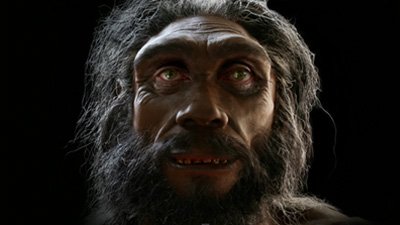
In addition to demonstrating that Neanderthal intellectual abilities were equal to complex tasks, Bruniquel’s stone circles demonstrate that the Neanderthals who built the mysterious rings and mounds must have had a social organization and culture more complex than anthropologists (at least evolutionary ones) have thought possible. Thanks to evolutionary propaganda that painted Neanderthals as less evolved than modern humans, the very word Neanderthal once conjured up images of brow-ridged, grunting brutes. Anthropologists have continued to debate whether Neanderthals had the capacity for abstract, symbolic thought, although mounting evidence has long demonstrated that the Neanderthals behaved in many ways like modern humans. They made complex tools and jewelry, drew with pigmentscooked vegetables, used bitter medicinal herbs, cared for their infirm companions, and buried their dead.2
Like us, Neanderthals were predominantly right handed. Having a dominant hand is a uniquely human trait that, neurologically speaking, indicates some of their brain functions were lateralized, an essential prerequisite for language. Though they left no written account of themselves, they possessed the same form of the FOXp2 gene that makes language learning possible in modern people. And DNA evidence demonstrates that Neanderthals mixed not only with other ancient people groups but also with early modern humans, leaving their genetic footprint in people of today, particularly in the modern immune system. Yet because they left no great edifices that could survive for millennia as the pyramids of Egypt have, archaeologists have until now lacked proof of their architectural abilities and organizational skills.
This is not the first time cave discoveries have shown that Neanderthals could organize their space. (See “Neanderthals, Like Other Humans, Heated Water, and Organized Their Homes.”) But it is the first evidence demonstrating that Neanderthals could not only explore deep inside caves—336 meters (about 1,100 feet) from the current entrance, far from any natural light source—but also conquer those deep spaces by filling them with light and their own neatly planned constructions.

Constructions in the Cave

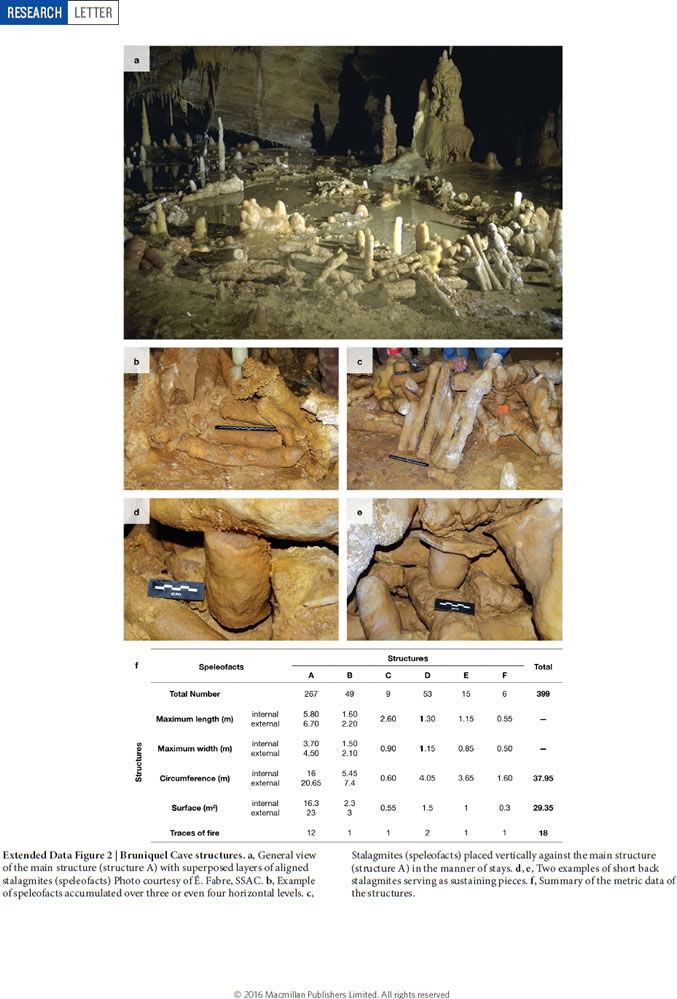
These are the first man-made, early Middle Paleolithic stalagmite constructions ever found. “The structures are spectacular and have virtually no equivalent for that period, and even for more recent periods,” explains Jacques Jaubert, lead author of the report published in Nature.3 And paleoanthropologist Chris Stringer of London’s Natural History Museum agrees: “These must have been made by early Neanderthals, the only known human inhabitants of Europe at this time.”4 The low walls and stacks are built of over 400 pieces of stalagmite. Half of these consist of the middle section of a stalagmite with the root and tip removed. Places are visible where some of the stalagmites were wrenched up from the cave floor, but others may well have been hauled in from elsewhere. Altogether these Neanderthals produced and placed about 2.2 tons of stalagmite pieces, each about the length of a forearm.5
ALTOGETHER THESE NEANDERTHALS PRODUCED AND PLACED ABOUT 2.2 TONS OF STALAGMITE PIECES, EACH ABOUT THE LENGTH OF A FOREARM.
Located in the largest chamber in Bruniquel Cave, the semicircular walls demarcate spaces 6.7 x 4.5 meters (about 22 by 15 feet) and 2.2 x 2.1 meters (about 7 x 7 feet) across, respectively. The walls are made of four layers of stacked uniform pieces of stalagmites, each about 34.4 cm (13.5 inches) long. The stalagmite “bricks” are carefully aligned, and some short pieces are interspersed between them for additional support. Vertical buttresses stabilize the walls. Four stacks of stalagmites ranging 0.55 to 2.60 meters (roughly 2 to 8.5 feet) in diameter, two inside the large ring, add to the mystery of just what the Neanderthals were thinking. These stacks are clearly not just piles of extra building material, as the stalagmites in them are shorter, about 29.5 cm (about 11.5 inches) in length.6
There are a lot of fire markings, red and black cracks, on all six structures. How do the archaeologists know the colors and charred cracks were made by fire and not just dripping cave minerals? Spectrometry and magnetic measurements of these spots on the walls and stacks and on a burnt piece of animal bone are consistent with exposure to fire.7
Neanderthal Construction
This page from Jaubert’s study published in Nature shows the chamber containing the calcite-covered Neanderthal constructions in photograph (a). Several horizontal layers of stalagmites are stacked in (b). The wall is buttressed by vertical pieces, as shown in (c). Photographs (d) and (e) show short pieces of stalagmite squeezed in to support others. Image from Jacques Jaubert et al., “Early Neanderthal Constructions Deep in Bruniquel Cave in Southwestern France.” Photograph (a) was provided to the study’s authors by É. Fabre of the Speleological & Archaeological Society of Caussade.

Implications of the Discovery

This was a labor-intensive project. The authors who excavated and analyzed it write:
This type of construction implies the beginnings of a social organization: this organization could consist of a project that was designed and discussed by one or several individuals, a distribution of the tasks of choosing, collecting and calibrating the speleofacts [stone artifacts], followed by their transport (or vice versa) and placement according to a predetermined plan. This work would also require adequate lighting. The construction of such a structure, involving the placement and arrangement of speleofacts, supposes a minimum degree of skill, since architectural techniques such as inserting wedging elements between two rows of speleofacts or placing stays to act as a buttresses, appear to have been used.8
Paleoanthropologist Chris Stringer admits, “This discovery provides clear evidence that Neanderthals had fully human capabilities in the planning and the construction of ‘stone’ structures, and that some of them penetrated deep into caves, where artificial lighting would have been essential.”9 Washington University paleoanthropologist Erik Trinkaus agrees: “The find is solid, and it is an important documentation of the advanced behaviors of the Neanderthals.”10 He adds, “This requires the mobilization of people who choose, who lead, who advise, manufacture—and with continuous light. All this indicates a structured society.”11
SO WHY DID THE NEANDERTHALS BUILD THESE RINGS AND STACKS?
So why did the Neanderthals build these rings and stacks? After all, if a cave only serves as shelter, it is not necessary to build stone circles in its dark recesses. Did they serve some ritualistic purpose? Provide a special place to gather for a meeting? Demarcate separate spaces for leaders or certain groups of people? Serve as a sheltered lunch counter? Offer a public works project to keep people busy in the winter? No one knows. But clearly the structures were built with great effort for some purpose.
While we may never know why the Neanderthals built them, these structures—sealed in a cave and coated with calcite—have been preserved for millennia for us to see. And they should change how we view Neanderthals. They should remind us that Neanderthals were people, descendants of Adam like ourselves. Just as Bible-believing creationists have been saying all along.

Presumptions and Preservation

Why haven’t more Neanderthal buildings been found? Why is Neanderthal artwork also found inside caves? Caves, especially sealed ones, offer a unique environment protected from the elements that make many artifacts disappear. We do not know therefore whether Neanderthals elsewhere really left much more of themselves behind than has been preserved.
The study’s author Jacques Jaubert concludes that, in view of the constructs in Bruniquel Cave and other Neanderthal discoveries, scientists can now be certain that the Neanderthal humans in Eurasia and the early modern human in Africa “were both at similar stages in technical development, with regard to tools, knowledge, spirituality, equipment for hunting and fishing.”12 That in fact is exactly what we would expect in light of biblical history.
Like early modern humans found in Africa, Neanderthals were descendants of people who dispersed from the Tower of Babel. Neanderthals in Eurasia would have had to find shelter and make a life for themselves as they dealt with the challenges of the post-Flood Ice Age. Yet we’ve seen that they had time and mind to be concerned with more than mere survival. Lumps of pigments, drawing tools, and cave art have already demonstrated this. And now we see that Neanderthals could execute a plan to build permanent structures for whatever future they envisioned.
People should not presume that Neanderthals were primitive and “less evolved” than modern humans just because we don’t have a lot of their paintings and buildings to look at today. Leiden University archaeologist Marie Soressi, commenting on the discovery for Nature, explains:
Perhaps we need to further consider the idea that the fuzziness of the Neanderthal record is due to a lack of preservation. Given that we often discuss archaeological findings in a comparative framework that contrasts Neanderthals (which disappeared) with early modern humans (who were obviously successful), we may also wonder how this framework is biased by Western thought. European culture is known for having emphasized what may be “uniquely human” and may separate “us” from other animals. . . . The structures discovered by Jaubert et al. are a good example of how reconstructing ancient history may benefit from not only broad-scale comparisons of evolution over time but also detailed analysis of specific areas at specific time points.13
The problem, however, is not just with Western thinking but with the evolutionary worldview that views humans of all varieties as highly evolved animals at different points on the evolutionary timeline. The evolutionary worldview is based on the presupposition that undirected, materialistic, natural processes created life and all its diverse complexity, even though nothing in observational science demonstrates that this is possible. The extraordinarily old dates assigned to Neanderthals all greatly exceed those from biblical history. Yet there is no way to objectively calibrate the various means used to “date” ancient people like Neanderthals and the artifacts they’ve left behind. Why? Because these great ages are based on the unverifiable, worldview-based presuppositions used to interpret scientific data. Like these dating methods, molecules-to-man evolutionary claims depend on what a person believes to be a reliable source of information about a time in history that cannot now be directly observed.
THERE IS NO WAY TO OBJECTIVELY CALIBRATE THE VARIOUS MEANS USED TO “DATE” ANCIENT PEOPLE LIKE NEANDERTHALS AND THE ARTIFACTS THEY’VE LEFT BEHIND.
When it comes to making sense of the unobservable, untestable past, we must interpret what we see in light of what we consider to be a reliable source of information about what happened back then, a time that no scientist was around to observe. But there is only one eyewitness to all of history, to the time of human origins. The Creator God of the Bible created exactly two human beings—Adam and Eve—on the sixth day the earth existed, about 6,000 years ago. He told us so in the Bible. He made these humans in His own image. They did not evolve from the animals, which He also created. Once we understand that the history in God’s Word is reliable, then we will not be surprised at evidence that Neanderthals were as fully human as we are, with the same sort of abilities that people have today.

Wednesday, June 8, 2016

WND Exclusive Tiny Christian church in holy war with Islam Mayor tries to 'bully' pastor into changing Bible message

image: http://www.wnd.com/files/2016/06/belmont-drive-missionary-baptist-sign.jpg
Belmont Drive Missionary Baptist sign in Hood River, Oregon.
A local pastor at a tiny church in Hood River, Oregon, a small town on the banks of the Columbia River, is taking on the world’s fastest growing religion and not backing down.
The Rev. Michael Harrington, 74, leads the Belmont Drive Missionary Baptist Church in a rural outpost along I-84 about an hour and 10 minutes east of Portland.
The church is so small it doesn’t even have a website.
It’s main method of communicating with the outside world is its outdoor marquee sitting out front of its building along a highway that few travel.
Harrington posted messages last month on the board that read: “Wake up Christians. Allah is not our God. Muhammad not greater than Jesus.”
The other side of the marque stated “Only the Bible is God’s Word. Koran is just another book.”
In a matter of days word spread to Muslim groups and their left-leaning supporters well beyond Hood River. About a dozen protesters descended on the small church with signs saying “take down this sign.”
This church is so small it often can’t muster more than a dozen members for a Sunday service.
“There may be, on a good day, 30 cars go by and see our sign,” said Pastor Harrington. “My intent was anybody who agrees with that come on in, and anyone who disagrees with it, come in and we’ll talk about it.”
But that wasn’t the case.
This simple expression of religious conviction was too “controversial” for some to tolerate.
One man, Eric Cohn, was riding his bike by the church one day and said he “could not believe” what he was seeing. He stopped and told the pastor he wept because he was so offended by the message on the reader-board.
“I literally had to stop and back up and make sure I saw what I saw, and I was profoundly offended and upset by it,” Eric Cohn told KomoNews.com.
Cohn was so offended he wrote a letter to the editor in the local newspaper that Harrington says painted him “as a terrorist almost.”
The big-city paper, the Oregonian in Portland, also filed a report  lecturing the pastor on what is “appropriate Christian behavior.”
Then the local mayor intervened with comments that helped stoke the controversy.
“I was really annoyed and sad. I am annoyed that in this political season there’s a solid case of ugly going on,” Mayor Paul Blackburn told KATU in an effort to smear the pastor of the tiny church. “I think it norms up this kind of behavior like ‘oh, it’s okay to be a bigot now.'”
The pastor was forced to defend himself in the local and national media.
“I’m not politically correct. I’ve never been politically correct, but I think I’m biblically correct, and that’s what matters to me,” Harrington told KATU. “It isn’t against any particular denomination. It’s just the fact that I have taught and will continue to teach that I have one God, one way of salvation and one Bible that’s holy.”
Fair enough, right? We all have freedom of religion and freedom of speech, and Americans are generally tolerant folks, right? Not for some, such as the Raw Story, which called the pastor out as a bigot.
Watch video interview with Pastor Michael Harrington:

Read more at http://www.wnd.com/2016/06/tiny-christian-church-in-holy-war-with-islam/#A73JEiHDrYdwDdFu.99

Should Animals Have Equal Rights as Humans? by Ken Ham and Avery Foley on June 7, 2016

       
It’s not uncommon to see animals exalted and valued far above humans. Animal rights groups, such as PETA (People for the Ethical Treatment of Animals), vehemently fight against the use of animals for anything, saying things such as, “Animals are not ours to eat, wear, experiment on, use for entertainment, or abuse in any other way”1 and “When it comes to pain, love, joy, loneliness, and fear, a rat is a pig is a dog is a boy. Each one values his or her life and fights the knife.”2What should a Christian’s response be to these arguments?

If Humans Are Just Animals Then . . .

Well, it’s important to first note the inconsistency of most animal rights groups. These groups claim to be against animal abuse, but are these same people against the abuse of millions of children who are brutally murdered in their mother’s wombs through abortion?
It’s rather ironic that in PETA’s evolutionary worldview humans are just animals, yet PETA does not petition against the “animal cruelty” of killing unborn children. And what about a Save the Tapeworms Society or People for the Preservation of Fruit Flies?
PETA Logo
If all life evolved, shouldn’t these groups be against killing these creatures too? Yet most animal rights groups are not trying to preserve pests like these. This highlights their inconsistency. And if they are evolutionists, then all life, animals and plants, are related in the one big supposed evolutionary tree of life. So what about rights for plants too?
Now some animal rights people claim they are Christians. If so, then they need to understand that God gave man dominion over creation (Genesis 1:26), including over the animals. This dominion does not mean we can deliberately abuse, neglect, or harm creation, but rather, we’re to use what God has made for our good and His glory. In Genesis 1:29 and 30, God told man to eat plants/fruits. But in Genesis 9:3 after the Flood, God said we could eat all things (plants and animals).
Animal rights groups really want animals to have dominion over man. Yet, ironically, most would claim that man is just an animal. So if they want equal rights for animals, what rights should humans have if they believe man is just an evolved animal?
For example if animals kill other animals, do animal rights groups think humans (if we’re just animals) should have equal rights to kill too? Why should we be held to some higher standard or different moral code from other animals?
If animals steal from other animals, do animal rights groups think humans (if we’re just evolved animals) should have equal rights to steal? What about incest, cannibalism, or infant abandonment? Why are these things wrong for humans but not wrong for “other” animals? If animal rights activists were consistent, they should argue that it is okay to steal from animals, kill them, and eat them—since this is what we regularly observe in sin-cursed animals anyway.

Where Do Rights Come From?

In an evolutionary worldview, what makes animal rights activists think that rights exist in the first place? Rights are an abstract concept that comes from a biblical worldview, which is denied by the evolutionary position. The evolutionary position, which comes out of naturalism and materialism, cannot account for the concept of rights, because they are not material. In other words, the evolutionary materialist must borrow the concept of rights from Christians to argue against the Christian position of man being superior and in dominion over animals.
If animals are no different from humans, then why aren’t ringworms making the argument for animal rights, instead of people? We don’t observe the organization of ringworms called the Ringworms for the Ethical Treatment of Animals or RETA. In the animal rights activists’ heart of hearts, they know man is above animals. What they don’t know is why. It is because man is made in the image of God (Genesis 1:26–27).

Evolutionary Morality—Hopelessly Inconsistent

Those who start with an evolutionary view of mankind have no absolute basis for morality. Because they have no foundation, they are forced to construct a moral code that is “right in their own eyes” (Judges 21:25). This leads to all kinds of inconsistencies.
Evolutionists arbitrarily create or hold to a moral code for humans—which, in their view, includes not using anything that comes from or was even tested on animals—yet they believe we are just animals. So why should we be held to this arbitrary standard that no “other” animal is held to?
After all, no one blames a lion for ripping apart a gazelle, or a hyena for trying to steal the carcass, or microbes for finishing off the gazelle’s remains. But somehow humans are arbitrarily viewed as different despite the insistence that we aren’t different.
Lunch for a Lion
Consider if evolutionary animal rights groups are right in saying there is no distinction between man and animals.3 Then what is to say there is a distinction between animals and plants? Perhaps the argument should be to also refrain from any plant use. It wouldn’t take long for the animal/plant rights activists to die of starvation.
AN EVOLUTIONARY VIEW OF MANKIND AND MORALITY LEADS TO INCONSISTENCY AND CONFUSION.
An evolutionary view of mankind and morality leads to inconsistency and confusion. It’s only when we start with God’s Word that we get a firm foundation for morality. We are not animals; we were specially and uniquely created in the image of God, separate and distinct from the animals (in a similar fashion, animals are not created like the plants either).
We are morally accountable to our Creator, and His Word has provided us with clear guidelines of how we are—and are not—to behave. Murder and theft are wrong because our Creator has decreed that we are not to kill (Genesis 4:8–11Exodus 20:13) and we are not to steal (Exodus 20:15). Eating meat is not morally wrong because, after the global Flood, God gave mankind permission to eat meat (Genesis 9:3). Jesus Himself even ate fish (Luke 24:41–43) and partook of the Passover lamb (Luke 22:7–22).
We are not left drifting in an inconsistent moral sea of man’s opinions. Starting with God’s Word, we have a firm foundation for morality.

“Let Them Have Dominion”

Most animal rights groups start with an evolutionary view of mankind. They view us as the last to evolve (so far), as a blight on the earth, and the destroyers of pristine nature. Nature, they believe, is much better off without us, and we have no right to interfere with it. This is nature worship, which is a further fulfillment of the prophecy in Romans 1 in which the hearts of sinful man have traded worship of God for the worship of God’s creation.
But as people have noted for years, nature is “red in tooth and claw.”4Nature is not some kind of perfect, pristine place. And why is this? Because mankind chose to sin against a holy God. When Adam and Eve disobeyed God’s command, they brought death, suffering, and the Curse into creation (Genesis 2:173:17).
Now all of creation groans, waiting for the coming day when Jesus will liberate it from the Curse (Romans 8:20–22Revelation 22:3). Creation was never designed to live in disharmony. We, and the animals, were originally created to be vegetarian (Genesis 1:29–30) and to live forever without any suffering or disease. But because sin changed all of that, we battle its effects every day.
But this doesn’t mean that humans are a blight or disease. Despite our sin, we are the only ones created in the very image of God, utterly unique from the rest of creation. We were granted dominion over the earth and it’s inhabitants (Genesis 1:26). This was part of our “very good” (Genesis 1:31), pre-Fall purpose and mission, and it stems out of our position as image bearers of the Creator.

How Should We View “Dominion”?

But does having dominion mean that we can treat animals any way that we want to? No! Such a view stems from a misguided view of our dominion over creation. It exalts humans while devaluing the rest of God’s creation.
DOES HAVING DOMINION MEAN THAT WE CAN TREAT ANIMALS ANY WAY THAT WE WANT TO? NO!
You see, God takes great joy in His creation. Six different times before He created mankind, God looked at what He had made and called it “good” (Genesis 1:41012182125). Scripture is full of celebrations of creation’s beauty and God’s care for what He has made (Matthew 6:3010:29).
And in Proverbs 12:10 we read, “A righteous man regards the life of his animal.” The testimony of Scripture as a whole paints the picture of a Creator who loves and cares for allthat He has made. As those made in His image, we should love and care for what He has made too.
So the response here is not to point out that all of what animal activists are saying is wrong. We need to be discerning based on God’s Word. The problem is that the activists have gone too far, to a point where they are essentially worshipping animals.

A Balanced Position

In our world of harsh, contrasting sides, it’s often difficult to find a balance. There’s a temptation to fall into either ditch: exalting animals above humans or devaluing God’s other creations.
As Christians, we need to find a proper balance based on Scripture. Humans alone are made in the image of God: we’re unique and therefore have a unique place in God’s creation. Jesus Himself became a man and died on the Cross to save mankind, not the animals.
This doesn’t mean we can treat the rest of God’s creation cruelly or abusively. We need to reflect the heart of the One whose image we are made in, and treat His creation with kindness, directing glory to our Creator and Savior.

Footnotes

  1. “What PETA Really Stands For,” PETA, http://www.peta.org/features/what-peta-really-stands-for/.
  2. “Why Animal Rights?,” PETA, http://www.peta.org/about-peta/why-peta/why-animal-rights/.
  3. Take note of how animal rights activists are actually trying to use Eastern Religions like Hinduism here. In Hinduism, they believe there is no distinction and that all is really one. The animal rights people hold that there is no distinction between man and animals, but if they kept going, like Hindus do, then there would be no distinction between anything.
  4. From “In Memoriam A. H. H.” by Alfred Lord Tennyson, 1850.

Man Awakens After 12 Years in a “Vegetative State,” Says “I Was Aware of Everything”

  Man Awakens After 12 Years in a “Vegetative State,” Says “I Was Aware of Everything” National   |   Sarah Zagorski   |   Jan 12, 2015   | ...