Sunday, June 19, 2016

VIDEO: BRITISH IMMIGRANT EXPLAINS SIGNIFICANCE OF CHRISTIAN, CONSTITUTIONAL VALUES "This is a battle between light and darkness, period

http://www.youtube.com/watch?v=jZtaicUiPIg&sns=em

Chalk It Up to a Global Flood Science in Perspective From Answers in Genesis (answer singleness.org)

by Dr. Andrew A. Snelling on 
Share: 
       
Email Using: 
At today’s rate of ocean-floor buildup, chalk layers would take millions of years to form. How do creationists explain them?
SC-RA-A-A-TCH! Skeep. Skri-i-itch. 
Those sounds filled the classrooms when I was growing up in Australia, as teachers wrote with sticks of chalk on the chalkboards that lined the front of every classroom. It’s been a long time since teachers have regularly used those tools, but chalk has made a big comeback among craft-lovers, thanks to the spray paint that can turn any surface into a chalkboard. 
When I was a boy, cringing at the occasional chalk squeak, I never realized these small white sticks actually came from a thick layer of rock made up of microscopic fossils. 
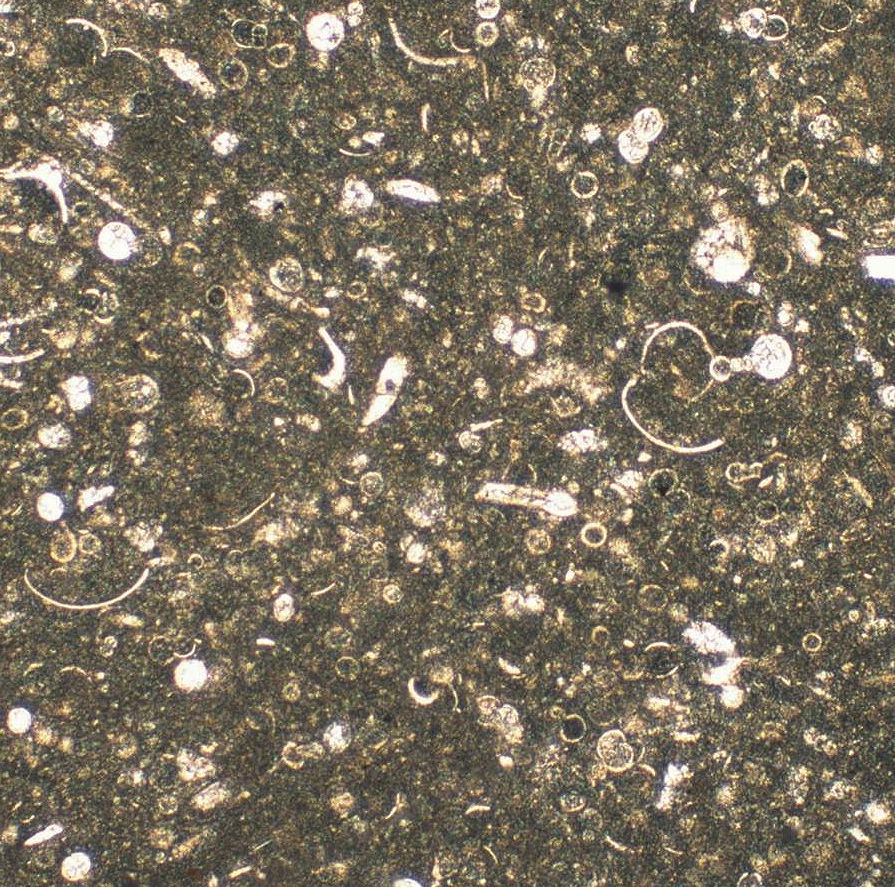
That’s what chalk is: a soft, pure, fine-textured limestone that has a marine origin and is usually white. It consists primarily (90–99%) of the mineral calcite, formed mainly by the shells of floating microorganisms, set in a very fine matrix.1
I learned that fact years later in my university geology class, where I was also taught about the famous White Cliffs of Dover along the coast of southern England. These cliffs are actually beds of chalk 350 feet (110 m) high. What a thrill it was when I later stood on the seashore looking up at these tall white cliffs! 
The thrill was marred by one thought: university geology classes teach that these beds of chalk required millions of years to be deposited, as very tiny shells slowly sank and settled on the seafloor and mixed with lime to form an ooze. 
Because of chalk bedsʼ fine-grained consistency and voluminous tiny fossil shells, evolutionary geologists have sought to explain their formation based on the limey ooze on today’s ocean floor. This ooze is widespread at depths shallower than 14,775 feet (4500 m). Evolutionary geologists claim that the ooze has accumulated one grain at a time, at a rate of between 0.008 and 0.08 inches (0.2–2 mm) per year.2 The ooze consists almost entirely of the tiny shells of single-celled creatures, because fish and other large creatures get eaten or decay before they even reach the seafloor.
So it would take 100,000 to 1 million years to accumulate the 650-foot (200 m) thickness needed for the homogenous ooze to be converted into chalk. Evolutionists claim the process of depositing chalk lasted for 40 million years.3 That’s the interpretation I heard in my university class, too. 
However, since I’m a Christian who believes that God’s Word provides the true account of the earth’s history, and I don’t believe the earth is millions of years old, how could I respond? 
Let’s do some digging to resolve this apparent enigma of the chalk beds. 
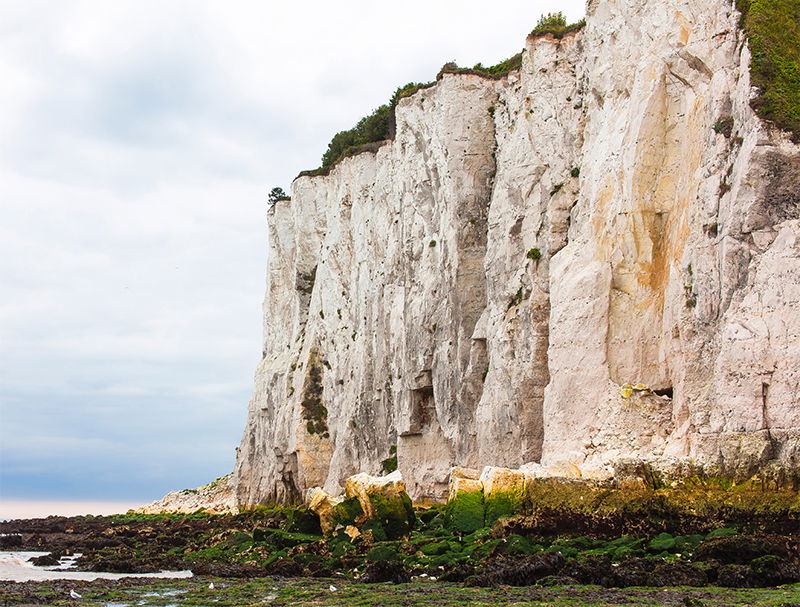
Cliffs of Dover
Cliffs of Dover

The Extent of the Chalk Beds 

First, let’s take a look at where the main chalk beds are located. The white chalk cliffs of Dover are an iconic English landmark, but similar chalk cliffs are also found to the west along the southern English coast near Brighton, and to the north along part of the Yorkshire coast. The chalk beds that connect these areas are estimated to average over 1300 feet (400 m) in thickness. The same chalk beds also crop out along the Antrim coast of Northern Ireland, and can be traced right across Europe (France, Germany, Poland, and beyond) to Turkey, Egypt, Israel, and even Kazakhstan. 
Similar chalk beds are found in the Midwestern USA, from Nebraska to Texas, and from Alabama to Colorado. They include the Niobrara Chalk in Kansas, which is famous for its astonishing variety of fossils. Chalk beds are also found in the Perth Basin of southern Western Australia (the Gingin Chalk) and contain the same fossils as the English chalk beds, as well as the same types of rock layers above and below them. 
ALL THESE CHALK BEDS ARE AT THE SAME RELATIVE LEVEL IN THE GLOBAL GEOLOGIC RECORD. SO THEY REPRESENT ONE GLOBAL SEDIMENTARY ROCK UNIT.
All these chalk beds are at the same relative level in the global geologic record. So they represent one global sedimentary rock unit. This similarity explains why they have all been assigned to the Cretaceous geologic period. (The name itself is derived from creta, the Latin word for chalk.) Since they’re all at the same level, we know all these chalk beds were deposited at the same time. 
But did these chalk beds take 40 million years to accumulate? Absolutely not. The unusual, jumbled mix of fossils dispels the evolutionary scenario of slow-and-gradual accumulation of tiny grains in a placid sea over 40 million years. 

The Fossils in the Chalk

The chalk fabric consists primarily of the tiny fossil remains of single-celled organisms called foraminifers, and of coccoliths (tiny plates which were the external skeletons of certain kinds of algae), set in a very fine-grained calcite. Even more important is the existence of so many larger fossils found mixed in the chalk beds. How did all these large, diverse creatures get buried in the ooze, unlike what we find on the ocean floor today? 

Massive Burial
Image courtesy of Andrew A. Snelling

Massive Burial

Chalk beds are found all over the world, made of tiny fossil shells from dead microorganisms. The ooze on the ocean floor accumulates too slowly to explain such thick chalk beds worldwide. So they must have been deposited in one massive burial.
The list of large fossils is huge. English chalk bed fossils include many big seafloor animals like sponges, corals, bryozoans (lace corals), brachiopods (lamp shells), bivalves (clams), gastropods (snails), ammonites, nautiloids, belemnites, arthropods (crabs and lobsters), and echinoderms (crinoids, starfish, and anemones).4 The chalk beds also contain a host of other creatures—the fossilized jaws and teeth of fish, and fossil remains of turtles, ichthyosaurs, plesiosaurs, marine lizards, flying reptiles (pterosaurs), and even dinosaurs, which lived on land. 
The Niobrara Chalk in Kansas contains an even more impressive list of larger fossils—fish of various types up to 16 feet (5 m) long, sharks, turtles up to 13 feet (4 m) long; plesiosaurs up to 46 feet (14 m) long; mosasaurs up to 49 feet (15 m) long; pterosaurs with wingspans up to 30 feet (9 m); dinosaurs, such as ankylosaurs and hadrosaurs, up to 30 feet (9 m); and birds up to 6.5 feet (2 m) tall.5
How could so many large ocean-dwelling and land-dwelling creatures get buried together in ooze on the ocean floor in the past, when this is not happening today? 
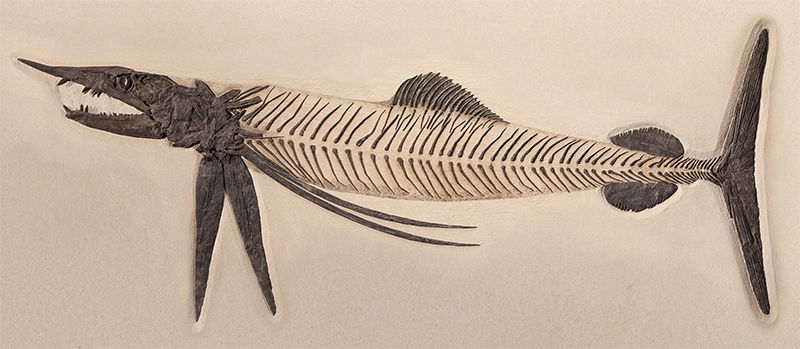
Rapid Burial
Heritage Auctions | HA.COM

Rapid Burial

Large creatures, such as this extinct swordfish (Protosphyraena nitida) are buried in chalk layers. The ooze on the ocean floor accumulates too slowly today to bury fish and other large animals before they get eaten or decay. So they must have been buried quickly before decay was possible.

The Biblical Flood Perspective

Skeptics claim that it is impossible for the chalk beds to have been rapidly deposited during the yearlong biblical Flood. They say it would take a long time for the trillions of foraminifers and coccoliths to breed, grow, die, and be buried to produce these thick chalk beds all around the globe. 
When they say this, they assume that ocean water conditions have always been like they are today. But during the global Flood cataclysm, water conditions were very different—hot volcanic waters and nutrients changed the water temperature and chemistry, which caused the rapid blooming of foraminifers and coccoliths in just hours, days, or weeks, not millions of years.6
These skeptics also ignore the fact that these chalk beds were deposited across the continents by ocean waters that rose high enough to completely flood the continents.
Meanwhile, the chalk beds are not found under the ocean floor where the limey ooze is today. And today’s limey oozes are nowhere near as pure in calcium carbonate as the chalk beds formed in the past. 
Where do we see limey ooze slowly accumulating on the continents today—and burying and fossilizing huge ocean dwellers (like the extinct plesiosaurs and mosasaurs) together with large land dwellers (like the extinct dinosaurs and pterosaurs)? Or what about the fossil found in the Kansas beds of the voracious predatory fish Xiphactinus audax, 13 feet (4 m) long with a nearly perfectly preserved 6-foot-long (1.8 m) fish Gillicus arcuatus inside of it? 
Nowhere! We simply do not see such burial and fossilization happening today on such a massive and catastrophic scale. 
To fossilize such large creatures, ginormous amounts of sediments had to bury them instantly before the creatures had time to escape. Fish are known to decompose quickly unless they are completely buried within a few days. Yet the fish found fossilized in the chalk beds show no signs of decay. So the claim that the chalk beds accumulated slowly—one grain at a time falling to the bottom of a placid sea—is demolished by the evidence of all these catastrophically buried fossils. 
Now also remember that these chalk beds stretch around the globe. So a global distribution of the chalk beds required a global Flood cataclysm, just as the Bible describes. 

Chalk It Up to Assumptions

So what is the underlying message we have dug up? Never be discouraged or dissuaded from believing what God’s Word teaches just because a few skeptics raise what seem to be difficult questions or insist they have evidence that contradicts the Bible. As in this case, closer examination reveals that what they claim as “evidence” is really their interpretation of the data based on their assumption that the Genesis Flood never occurred. 
Like the scoffers Peter warned about in 2 Peter 3, they are willfully ignorant or deliberately rejecting God’s Word, and thus they refuse to consider any interpretation of the evidence that would point to the Genesis Flood having occurred. Instead, they are trying to prove what they have already assumed. 
But for those of us who seek to know the Lord and understand His work, good answers can be found. Just look at common chalk. It offers phenomenal evidence for the veracity of the biblical Flood—yet another testimony that we can trust God and His Word. Chalk another one up to God’s Word.
Dr. Andrew Snelling holds a PhD in geology from the University of Sydney and has worked as a consultant research geologist in both Australia and America. Author of numerous scientific articles, Dr. Snelling is now director of research at Answers in Genesis–USA.

From David Hocking's Newsletter (davidhocking.org) THE WEST'S MOST POWERFUL ALLY: ISLAMIC DISSIDENTS


by Giulio Meotti (Aruta Sheva News)

Europe should give financial, moral and political support to courageous Islamic dissidents, friends of Western civilization, but instead our disgraced intelligentsia is engaged in slandering them.

Islam, warned the best-selling Algerian novelist, Boualem Sansal, is going to split European society. In an interview with German media, this brave Arab writer painted a vision of Europe subjugated by radical Islam. According to Sansal, the terror attacks in Paris and Brussels are directed at the Western way of life: "You cannot even defeat the weak Arab states, so they have brought in fifth columns to bring the West to destroy itself. If they succeed society will fall."

Mr. Sansal, who has been threatened with death, belongs to a rapidly growing army of Muslim dissidents. They are the best liberation movement for millions of Muslims who aspire to practice their faith peacefully without submitting to the dictates of fundamentalists and fanatics.

These Muslim dissidents pursue freedom of conscience, interreligious coexistence, pluralism in the public sphere, criticism of Islam, and respect for the rule of common law.  For the Islamic world, their message could be devastating.  That is why the Islamists are hunting them down.

Today a new Iron Curtain has been erected by Islam against the rest of the world, and the new heroes are the dissidents, the apostates, the heretics, the rebels, and the non-believers.

It is always individuals, such as Lech Walesa, who make all the difference. The Soviet Union was defeated by only three beings: Ronald Reagan, Pope John Paul II -- and the dissidents. When Professor Robert Havemann died in East Germany, few people noticed it. This intrepid critic of the regime was confined under house arrest in Grünheide, guarded by the Stasi.  But the old professor never allowed himself to be intimidated.  He continued to fight for his ideas.
A hero of Czechoslovak anti-Communism, Jan Patočka, died under grueling police interrogation. Patočka paid the highest price for fighting silencing.  His brilliant lectures were reduced to a clandestine seminar. Although unable to publish, he continued to work in a tiny underground apartment.

Hunted by the KGB, Alexander Solzhenitsyn set down the chapters of his Gulag Archipelago and hid them with different trusted friends, so no one possessed the entire manuscript.  In 1973 only three copies existed. When the Soviet political police managed to extort the typist, Elizaveta Voronyanskya, to reveal one of the hideouts, thinking the masterpiece was lost forever she hanged herself.

Today a new Iron Curtain has been erected by Islam against the rest of the world, and the new heroes are the dissidents, the apostates, the heretics, the rebels, and the non-believers. It is no coincidence that the first victim of a fatwa was Salman Rushdie, an Indian-British writer from a Muslim family.

Pascal Bruckner called them "the free thinkers of the Muslim world." We should support them -- all of them. Because if the enemies of freedom come from free societies, those who kneel before Allah's enforcers, some of the bravest defenders of freedom come from the Islamic regimes.  Europe should give financial, moral and political support to these friends of Western civilization, while our disgraced intelligentsia is engaged in slandering them.

One, an Algerian author, Kamel Daoud, who called Saudi Arabia "an Isis that had made it," recently sparked an "Islamophobia" row for having directed his own anger at the naïve people, who he says ignore the cultural gulf separating the Arab-Muslim world from Europe.
Another, an Iranian exile, now in the Netherlands, the jurist Afshin Ellian, works at Utrecht University, where after the murder of Theo Van Gogh, he is protected by bodyguards. After the massacre at Charlie Hebdo, while Europe's media were busy in blaming the "stupid" cartoonists, Ellian promoted an appeal: "Don't let terrorists determine the limits of free speech."

Another brave dissident and author, Ayaan Hirsi Ali, had to flee from the Netherlands to the U.S., where she rapidly became one of most prominent public intellectuals.

The Moroccan Mayor of Rotterdam, Ahmed Aboutaleb, is also guarded by police.  He recently told fellow Muslims who protested against freedoms they found while living in the West to "pack your bags and f... off." A heroic Christian defender of these freedoms in the Netherlands, Geert Wilders, is now on trial accused of "discrimination." "I am in jail," he has said, referring to his safe houses, "and they are walking around free."

Many of these dissidents are women. Shukria Barakzai, an Afghan politician and journalist, declared war on Islamic fundamentalists after the Taliban's religious police beat her for daring to walk without a male escort. A suicide bomber blew himself up near her car, killing three.

Kadra Yusuf, a Somali journalist, infiltrated Oslo's mosques to denounce the imams, especially regarding female genital mutilation, not even required in the Koran or the Hadith (added by Mohammad).

Sherry Rehman called for "a reform of Pakistani blasphemy's laws." She risks her life every day. She is branded by Islamists "fit to be killed" for being a woman, a Muslim and a secular activist.
The Syrian-American author and psychiatrist, Wafa Sultan, was also branded an "infidel" deserving of death.

Le Figaro recently published a long report about Muslim French personalities threatened with "execution". "Placed under permanent police protection, regarded as traitors by Muslim fundamentalists, they live in a hell. In the eyes of Islamists, their freedom is an act of betrayal of the ummah [community]."

They are writers and journalists of Arab-Muslim culture who denounce the Islamist threat and the inherent violence of the Koran. They stand alone against Islamism which uses the physical terrorism of Kalashnikovs, and against the intellectual terrorism which submits them to media intimidation. Seen as 'traitors' by their communities, they are accused by the élites in the West of stigmatizing."

The French journalist Zineb El Rhazoui has more bodyguards than many ministers in the government of Manuel Valls, and for security, has had to change houses in Paris often in recent months. For this young scholar, born in Casablanca and who works at the French weekly, Charlie Hebdo, walking down the street in Paris has become unthinkable.  A fatwa put out after January 7, 2015 reads: "Kill Zineb El Rhazoui to avenge the Prophet."

Threats against another dissident, Nadia Remadna, do not come from Raqqa, Syria, but her own city: Sevran, in Seine-Saint-Denis. They reflect the growing influence of Islamists in the lost territories of the French Republic. What "crime" was she found guilty of? She created the "Brigade of Mothers" to combat the Islamist influence on young Muslims.
A philosophy teacher, Sofiane Zitouni, has also quit his job at a Muslim French school over "insidious Islamism."

The French-Algerian journalist, essayist and author of several investigations into Islamist circles, Mohamed Sifaoui, is the victim of a double threat. He is a prime target for both fundamentalists and the "tolerant" grand inquisitors.

Sentenced to two years in prison by the Algerian regime for "press offenses," then harassed by Islamists, Sifaoui requested asylum in France in 1999 and has never set foot in Algeria again. Since then, Sifaoui has seen his picture and name next to the words "le mourtad," the apostate, on Islamist websites, meaning that he is targeted for death.

French police protection around him has been total since 2006, when he defended freedom of expression for the French satirical magazine, Charlie Hebdo.
About fifteen witnesses made a deposition in favor of the magazine, Charlie Hebdo.

Among them were the late Muslim Tunisian essayist, Abdelwahab Meddeb, who had the courage to challenge the entire French Muslim establishment which tried to stop Charlie Hebdo. Meddeb wanted to show "this is not about anyone against Islam, but enlightened Islam against 

Also in France, Hassen Chalghoumi, the courageous imam of Drancy, preaches while wearing a bullet-proof vest. When he goes out on the street, he is accompanied by five police officers with semiautomatic weapons. This is not outside Baghdad's Green Zone; this is in the heart of Paris. Chalghoumi backed the ban on burkas; made an unprecedented visit at Jerusalem's Holocaust memorial; paid tribute to the victims of Charlie Hebdo and favored a dialogue with French Jews.

Naser Khader, a Muslim liberal with Danish citizenship, who called for "a Muslim reformation," and authored "Honor and Shame," is threatened by Islamic groups with death.

In Italy, an Egyptian-born writer, Magdi Cristiano Allam, is protected by bodyguards for having criticized political Islam. As the deputy editor of Italy's leading newspaper, Corriere della Sera, Mr. Allam published a book whose title alone was enough to endanger his life: "Viva Israele."

Ibn Warraq lives protected behind a pseudonym since writing a seminal book, "Why I am Not a Muslim."

The Palestinian blogger Walid Husayin is also a rarity. Jailed for "satirizing the Koran, he recently published a book in France about his experience in the Palestinian Authority, where his "atheism" nearly cost him his life.

In Tunisia there are a handful of filmmakers and intellectuals who fight for freedom of expression, especially after a secular opposition leader, Chokri Belaid, was assassinated.

Nadia El Fani, the director of "Ni Allah ni maître" ["Neither Allah nor Master"], and Nabil Kari, the manager of Nessma TV, are also threatened with death and are being taken to court to answer charges of "blasphemy." If Tunisia's "Arab spring" did not turn into an Islamist winter, as elsewhere, it is largely thanks to these dissidents.

Those heroes know what happened to their predecessors in "the war on Arab intellectuals." Writers such as Tahar Djaout were killed in 1993 by the Islamists in Algiers, as was the journalist, Farag Foda, famous for his sharp satires on Islamic fundamentalism.  Prior to his murder, Foda had been accused of "blasphemy" by the great mosque of al-Azhar. A dozen Bangladeshi bloggers have also been murdered in cold blood by Islamists for the "crime" of "secularism."
Last year, Egypt's President Abdel Fattah al- Sisi called for reforming Islam and the way it is taught as did Sunni Islam's leading cleric, Sheikh Ahmed al Tayeb, head of Cairo's al-Azhar University, the center of Sunni Islam. And he said it in Mecca, no less. Egypt's conservatives however did their best to tamp that down - at least for the moment.

There are, however, more and more dissidents successfully speaking out and leading bold, farsighted movements. In the U.S., M. Zuhdi Jasser, author of "A Battle for the Soul of Islam," and a practising physician, founded the American Islamic Forum for Democracy.

Last year, more than two dozen Muslim personalities promoted an appeal "to embrace a pluralistic interpretation of Islam, rejecting all forms of oppression and abuses committed in the name of religion."

In Canada, Raheel and Sohail Raza founded "Muslims Facing Tomorrow," and there is the outspoken Associate Professor of Political Science at the University of Western Ontario, Salim Mansur.

In the U.K., Maajid Nawaz heads the influential Quilliam Foundation, and Shiraz Maher, who defected from the Islamist organization, Hizb-ut-Tahrir, now serves as a Senior Fellow at the International Center for the Study of Radicalization at King's College London.

These are just a few of today's heroes. Some had to be left out; there were too many to list.

The proud and painful resistance of these "Allah's rebels" is one of the most beautiful testaments of our times. These "Allah's rebels" are also the only real hope of reform for the Islamic world -- and of preserving freedom for all of us.

Man Awakens After 12 Years in a “Vegetative State,” Says “I Was Aware of Everything”

  Man Awakens After 12 Years in a “Vegetative State,” Says “I Was Aware of Everything” National   |   Sarah Zagorski   |   Jan 12, 2015   | ...