Wednesday, May 25, 2016

Monday, May 23, 2016
What Is the Scriptural Understanding of Death? Creation and the Cross answersingenesis.org
by
Prof. Andy McIntosh
on
May 23, 2016
Increasingly, the view that God could have used evolution is permeating our evangelical churches. Dr. Terry Mortenson and Dr. Nathaniel Jeanson,
two of our speakers at AiG, recently visited the annual meeting of the
Evangelical Theological Society in Atlanta, Georgia. Papers were
discussed this year that 15 years ago one would never have thought of
being seriously put forward. Some papers are still being called
evangelical even though they express doubt that Adam ever existed. This
is serious indeed. Even the great John Stott stumbled in not recognizing
the seriousness of espousing the view that God somehow used a gradual
development of ape-like creatures and that one of these creatures was
breathed into and became Homo divinus.1
In his day, Spurgeon spoke of a Down-Grade Controversy, which is what
we have today concerning the authority of the Bible, particularly in
Genesis.
So why is Genesis theologically important? Genesis is important because it teaches that death came as a result of the Fall and was not present beforehand. In the ensuing sections we will see that death has a two-fold aspect and involves separation.
The origin of all death is certainly spiritual and is taught in Romans 6:23, “For the wages of sin is death, but the gift of God is eternal life in Christ Jesus our Lord,” and Hebrews 2:14, “That through death He might destroy him who had the power of death, that is, the devil.”
Adam was told not to eat of the tree of the knowledge of good and evil— Genesis 2:17, “But of the tree of the knowledge of good and evil you shall not eat, for in the day that you eat of it you shall surely die.” Literally this means, “dying, thou shalt die.” It is the view of the author that Genesis 2:17 could suggest two deaths (because this is explicit later in Revelation 20), but it is fully recognized that the repetition of Hebrew words is often used to add emphasis. Was physical death included? Yes, because after the fall, in Genesis 3:19, God states, “For dust you are, And to dust you shall return”
As we read the terrible events of Genesis 3, we see what death is: separation. First there is spiritual death, as Adam and Eve know they are separated from fellowship with God, whereas before sin, they enjoyed perfect fellowship with Him (some believe Genesis 3:8 hints that God had walked with Adam beforehand). The Lord knew where Adam was, but the question He asked him in verse 9—“Where are you?”—can also be applied to us. We see this developed in Romans 5:18: “Through one man’s offense judgment came to all men, resulting in condemnation.” God calls to the whole of the human race, “Where are you?” So Adam was already experiencing spiritual separation as he tried to hide with Eve from the presence of God and as he tried to clothe himself with leaves, which would wither. God then pronounces that Adam would die physically when He says, “To dust you shall return” (Genesis 3:19). And some nine hundred or so years later, Adam dies physically (we do not know how long it was between the Creation of Adam and the Fall).
This matter of spiritually being separated from God in the immediate consequence of the Fall is an important point when dealing with the argument of theistic evolutionists who maintain that Adam did not immediately physically die when he ate of the fruit. They are right of course that Adam did not immediately die physically, but he did immediately die spiritually. Those who believe in theistic evolution then go on to teach incorrectly that, therefore, it was only spiritual death that came as a result of the Fall. To resist this error, we need to understand that in Genesis 2:17 God was speaking not only of the immediate effect of separation from Him as a consequence of eating the fruit, but also of the physical death that would follow. In order to withstand the false teaching of theistic evolutionists who make the false assertion that spiritual death was the only consequence of the Fall, we must scripturally understand what death really is. And it is this that we look at in the following three sections.
 Notice also that the curse for sin does not come upon Adam and Eve but on the ground. God states in Genesis 3:17,
“Cursed is the ground for your sake; In toil you shall eat of it all
the days of your life.” Here we see God’s love for man in not
immediately banishing him to everlasting death (separation from God for
eternity in hell). God sets the example of bringing a blood sacrifice,
which, years later, may have been at the heart of the difference between
God’s acceptance of Abel’s sacrifice and not of Cain’s in Genesis 4.
Notice also that the curse for sin does not come upon Adam and Eve but on the ground. God states in Genesis 3:17,
“Cursed is the ground for your sake; In toil you shall eat of it all
the days of your life.” Here we see God’s love for man in not
immediately banishing him to everlasting death (separation from God for
eternity in hell). God sets the example of bringing a blood sacrifice,
which, years later, may have been at the heart of the difference between
God’s acceptance of Abel’s sacrifice and not of Cain’s in Genesis 4.
God also curses the serpent, but the curse does not come on Adam at this juncture.
Having established that the Scripture speaks of two deaths at the end of the Bible, it is clear that the first death is what we all experience as we leave this world—separation of body from spirit. This came as a result of the sin in the Garden of Eden.
Paul shows that this is the case in Romans 5:12: “Therefore, just as through one man sin entered the world, and death through sin, and thus death spread to all men, because all sinned.” Physical death was not known before the spiritual disaster that took place in Eden. And Paul again summarizes the contrast with Christ who brings life in 1 Corinthians 15:21–22: “For since by man came death, by Man also came the resurrection of the dead. For as in Adam all die, even so in Christ all shall be made alive.” There is no doubt that 1 Corinthians 15 is concerned with physical death and physical resurrection, so the clarity of this chapter and Romans 5 leaves no doubt that physical death followed the Fall of Adam.
Those who believe in theistic evolution and that God made Adam from a pre-existing brute have a real issue here in broken theology. They have no reason for Christ to go through the physical death which now follows, and it is important to grasp that physical death does now follows as Christ states, “Father, into Your hands I commit My spirit” (Luke 23:46). In John 19:30 we read, “And bowing His head, He gave up His spirit” (Greek: “He delivered His spirit”). The tense is active and not passive, so it is important to observe that Christ actively controlled His own physical death. As He stated in John 10:17–18, “Therefore My Father loves Me, because I lay down My life that I may take it again. No one takes it from Me, but I lay it down of Myself. I have power to lay it down, and I have power to take it again. This command I have received from My Father.” The giver of life at creation is now the one who controls both His own death and His own Resurrection. In fact, all of the Trinity are involved since it also says that God raises His Son. “He has appointed a day on which He will judge the world in righteousness by the Man whom He has ordained. He has given assurance of this to all by raising Him from the dead” (Acts 17:31). According to Romans 8:11, the Spirit also raises Christ from the dead: “The spirit of Him who raised Jesus from the dead.”
 Why did Christ physically die? Because that was indeed part of the
penalty for sin, and His glorious Resurrection assures us that we also
will eventually receive a new body. It is not in this body full of sin
and death that I shall see Him, but in a glorious, resurrected new body.
This mortal and corruptible body will become immortal and incorruptible
(1 Corinthians 15:53).
Why did Christ physically die? Because that was indeed part of the
penalty for sin, and His glorious Resurrection assures us that we also
will eventually receive a new body. It is not in this body full of sin
and death that I shall see Him, but in a glorious, resurrected new body.
This mortal and corruptible body will become immortal and incorruptible
(1 Corinthians 15:53).
When you understand the extent, magnitude, and far reaching effects of the death of Christ and the redemption He has purchased on our behalf, there is no way that this is consistent with a God who has made man from a pre-existing, dying creature beforehand. Theistic evolution undermines the Cross of Christ.
So why is Genesis theologically important? Genesis is important because it teaches that death came as a result of the Fall and was not present beforehand. In the ensuing sections we will see that death has a two-fold aspect and involves separation.
Man Died Spiritually and Physically as a Result of the Fall
The Fall and the Effect of the Curse on Creation
When sin came into the world, man died not just spiritually but also physically. He was not dying before.The origin of all death is certainly spiritual and is taught in Romans 6:23, “For the wages of sin is death, but the gift of God is eternal life in Christ Jesus our Lord,” and Hebrews 2:14, “That through death He might destroy him who had the power of death, that is, the devil.”
Adam was told not to eat of the tree of the knowledge of good and evil— Genesis 2:17, “But of the tree of the knowledge of good and evil you shall not eat, for in the day that you eat of it you shall surely die.” Literally this means, “dying, thou shalt die.” It is the view of the author that Genesis 2:17 could suggest two deaths (because this is explicit later in Revelation 20), but it is fully recognized that the repetition of Hebrew words is often used to add emphasis. Was physical death included? Yes, because after the fall, in Genesis 3:19, God states, “For dust you are, And to dust you shall return”
As we read the terrible events of Genesis 3, we see what death is: separation. First there is spiritual death, as Adam and Eve know they are separated from fellowship with God, whereas before sin, they enjoyed perfect fellowship with Him (some believe Genesis 3:8 hints that God had walked with Adam beforehand). The Lord knew where Adam was, but the question He asked him in verse 9—“Where are you?”—can also be applied to us. We see this developed in Romans 5:18: “Through one man’s offense judgment came to all men, resulting in condemnation.” God calls to the whole of the human race, “Where are you?” So Adam was already experiencing spiritual separation as he tried to hide with Eve from the presence of God and as he tried to clothe himself with leaves, which would wither. God then pronounces that Adam would die physically when He says, “To dust you shall return” (Genesis 3:19). And some nine hundred or so years later, Adam dies physically (we do not know how long it was between the Creation of Adam and the Fall).
This matter of spiritually being separated from God in the immediate consequence of the Fall is an important point when dealing with the argument of theistic evolutionists who maintain that Adam did not immediately physically die when he ate of the fruit. They are right of course that Adam did not immediately die physically, but he did immediately die spiritually. Those who believe in theistic evolution then go on to teach incorrectly that, therefore, it was only spiritual death that came as a result of the Fall. To resist this error, we need to understand that in Genesis 2:17 God was speaking not only of the immediate effect of separation from Him as a consequence of eating the fruit, but also of the physical death that would follow. In order to withstand the false teaching of theistic evolutionists who make the false assertion that spiritual death was the only consequence of the Fall, we must scripturally understand what death really is. And it is this that we look at in the following three sections.
The Fall and the Effect on the Covering of Adam and Eve
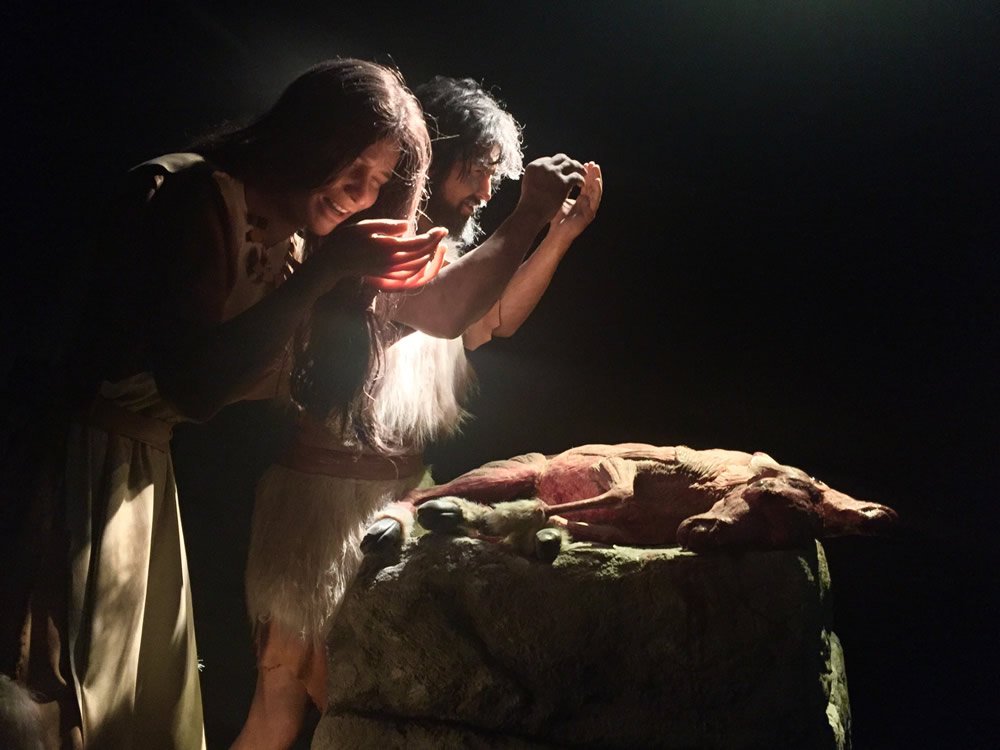
The pathetic covering of leaves is replaced by animal skins, which the Lord provides: “The Lord God made tunics of skin, and clothed them” (Genesis 3:21). So God killed an animal (possibly two)—perhaps from the goat/sheep kind. The first record of death is that performed by the Lord Himself. The Cross of Christ, and redemption to come, is already casting its shadow across Eden.
God also curses the serpent, but the curse does not come on Adam at this juncture.
The Fall and the Two Deaths Which Come on Humanity
The theological significance of two deaths (spiritual and physical) is borne out at the end of the Bible where Revelation 20:14–15 specifically states, “Death and Hades were cast into the lake of fire. This is the second death. And anyone not found written in the Book of Life was cast into the lake of fire.” The second death is referred to in Revelation 20:6, which states, “Blessed and holy is he who has part in the first resurrection. Over such the second death has no power” (see also Revelation 2:11). It is evident that those who believe in Christ will not experience the awfulness of being separated from God forever, but those who rebel against God will receive the final, irreversible punishment (Revelation 21:8)—the second death. As we shall see in the next section, the reason for this is that Christ took the awfulness of the second death on the Cross as He experienced the wrath of the Father against sin (2 Corinthians 5:21).Having established that the Scripture speaks of two deaths at the end of the Bible, it is clear that the first death is what we all experience as we leave this world—separation of body from spirit. This came as a result of the sin in the Garden of Eden.
Paul shows that this is the case in Romans 5:12: “Therefore, just as through one man sin entered the world, and death through sin, and thus death spread to all men, because all sinned.” Physical death was not known before the spiritual disaster that took place in Eden. And Paul again summarizes the contrast with Christ who brings life in 1 Corinthians 15:21–22: “For since by man came death, by Man also came the resurrection of the dead. For as in Adam all die, even so in Christ all shall be made alive.” There is no doubt that 1 Corinthians 15 is concerned with physical death and physical resurrection, so the clarity of this chapter and Romans 5 leaves no doubt that physical death followed the Fall of Adam.
Christ’s Death on the Cross Pays the Full Penalty for Sin
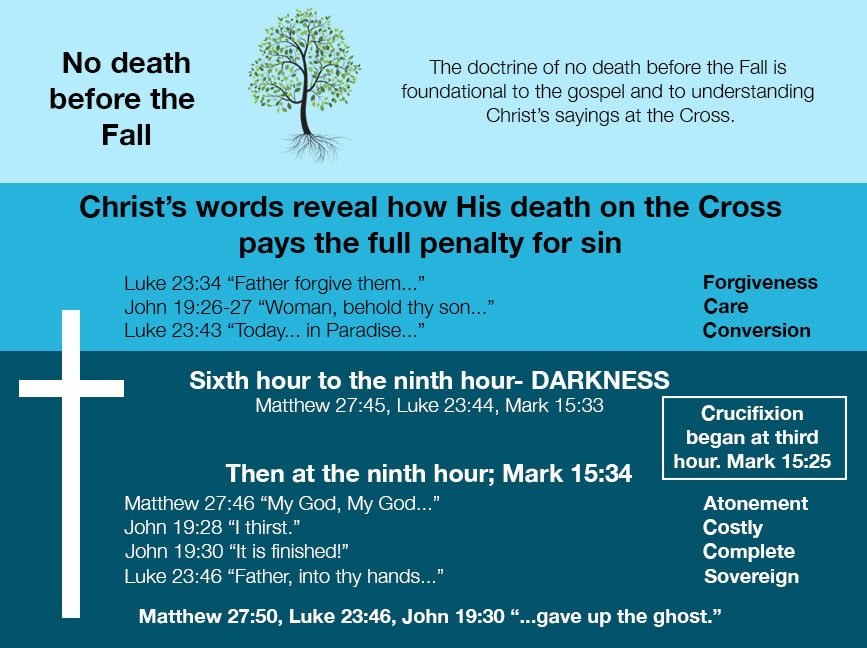
Having established that the punishment for sin involves the double penalty of separation of man from God and separation of spirit from body, let us now go to the Cross to see how these two deaths work through the amazing redemption purchased by Christ for us. Christ took the full punishment for sin in His own body. Christ was on the Cross for a total of six hours—He goes on the Cross at the third hour (Mark 15:25), and darkness comes upon the land from the sixth hour until the ninth hour (Matthew 27:45; Luke 23:44). Most authors regard the first three utterances recorded in Scripture as being in the first three hours while Christ was on the Cross (see the Figure 1).2 Now at the ninth hour (Mark 15:34), Christ utters the last four sayings one after the other. The intensity of the fourth saying is very powerful as He cries out, “My God, my God why have you forsaken me?” He quotes Psalm 22:1 and addresses God in a way different from the customary “Father.” He now is distant and separated from God the Father, and the second death comes upon Christ as He experiences God’s wrath against sin—what would be an eternity in hell for ordinary men. Never is His Sonship in doubt; yet it seems that, in a way we cannot fathom, He experienced separation from His Father. Perhaps the deepest statements in terms of the theology of the Cross are in these two verses:God was in Christ reconciling the world to Himself, not imputing their trespasses to them. (2 Corinthians 5:19)
He Himself is the propitiation [appeaser of wrath] for our sins, and not for ours only but also for the whole world. (1 John 2:2)Then He says, “I thirst” and cries out one word in Greek, Tetelestai, which is a legal word meaning “Complete”/“Done” (the obligation is fulfilled or brought to an end). The payment had been made. So why did Jesus not get off the Cross at this point if, in fact, the only payment for sin was spiritual death?
Those who believe in theistic evolution and that God made Adam from a pre-existing brute have a real issue here in broken theology. They have no reason for Christ to go through the physical death which now follows, and it is important to grasp that physical death does now follows as Christ states, “Father, into Your hands I commit My spirit” (Luke 23:46). In John 19:30 we read, “And bowing His head, He gave up His spirit” (Greek: “He delivered His spirit”). The tense is active and not passive, so it is important to observe that Christ actively controlled His own physical death. As He stated in John 10:17–18, “Therefore My Father loves Me, because I lay down My life that I may take it again. No one takes it from Me, but I lay it down of Myself. I have power to lay it down, and I have power to take it again. This command I have received from My Father.” The giver of life at creation is now the one who controls both His own death and His own Resurrection. In fact, all of the Trinity are involved since it also says that God raises His Son. “He has appointed a day on which He will judge the world in righteousness by the Man whom He has ordained. He has given assurance of this to all by raising Him from the dead” (Acts 17:31). According to Romans 8:11, the Spirit also raises Christ from the dead: “The spirit of Him who raised Jesus from the dead.”
Figure 1.
When you understand the extent, magnitude, and far reaching effects of the death of Christ and the redemption He has purchased on our behalf, there is no way that this is consistent with a God who has made man from a pre-existing, dying creature beforehand. Theistic evolution undermines the Cross of Christ.
Bill Nye debates Ken Ham (2 years ago)
Bill Nye Debates Ken Ham
on February 4, 2014
Watch Bill Nye debate Ken Ham on whether creation is a viable model of origins in today’s modern scientific era.


“There Is a Book . . .”
There were many defining moments in the historic debate between Bill Nye and Ken Ham at the Creation Museum in Northern Kentucky. For Ken Ham, one of those defining moments came when Bill Nye twice referred to origins as a “great mystery.” Each time, Ken Ham responded by saying, “There is a book . . .” Of course that book is the Bible, God’s Word, which gives us answers to the skeptical questions of the age.
Was there a defining moment that stood out to you during the debate? If not, it’s not too late! Your defining moment could be leading an outreach or just diving in to learn more so you can be ready to defend your faith. Your defining moment might even be receiving Jesus Christ as your Lord and Savior. Whatever that moment is for you, we would love for you to get connected with us and share your experience.
From David Hocking Newsletter
| |
|
Subscribe to:
Comments (Atom)
Man Awakens After 12 Years in a “Vegetative State,” Says “I Was Aware of Everything”
Man Awakens After 12 Years in a “Vegetative State,” Says “I Was Aware of Everything” National | Sarah Zagorski | Jan 12, 2015 | ...

-
Snatched Away October 28, 2019 For the Lord Himself will descend from heaven with a shout, with the voice of an archa...
-
Man Awakens After 12 Years in a “Vegetative State,” Says “I Was Aware of Everything” National | Sarah Zagorski | Jan 12, 2015 | ...

