News to Know
by Dr. Elizabeth Mitchell on August 10, 2016
Fish that scoot across land and up waterfalls demonstrate diversity
within created kinds, and the Sonic hedgehog gene shared by fish and
people is an example of our Creator’s common designs. However, neither
of these shows that terrestrial vertebrates evolved from fish.
News Sources
- Science: “Fish May Have Evolved to Live on Land More Than 30 Times”
- CBS News: “Blind Fish That Crawls on Land Holds Clues to Evolution”
- New York Times: “Researchers Find Fish That Walks the Way Land Vertebrates Do”
- Phys.org: “Sonic Hedgehog Gene Provides Evidence That Our Limbs May Have Evolved from Sharks’ Gills”
Like Henry Limpet (Don Knotts) in The Incredible Mr. Limpet of fictional movie fame, evolutionists have illustrated charts2 depicting transitions from fish to terrestrial vertebrates like us. Despite their rampant worldview-based colorization of a black-and-white reality that demonstrates no such thing, evolutionists are confident that there really was a fish-to-walker transformation (not the zombie kind). The latest research claiming to shed light on life’s evolutionary leap to land includes a study cataloging land-loving fish, another peering into the pelvis of a blind cavefish, and a third using Sonic hedgehog to resurrect an evolutionary tale tracing our legs back to the gills of cartilaginous fish.
Designed for Diversity of Respiration . . . or Evolving to Breathe?
All fish are vertebrates with gills and require water to live, but some are able to venture out of the water under the right conditions. Assuming that such amphibious varieties of fish should offer clues about the origin of amphibians (like salamanders) as well as terrestrial vertebrates like us, Australia’s Terry Ord and Georgina Cooke wondered how many fish families have amphibious varieties. They found 130 such species spread across 33 fish families. They concluded that the leap to land was more common than commonly thought. Taking a closer look at the blenny family, they determined that geography and ecological diversity repeatedly encouraged development of a wide range of amphibious varieties. The Pacific leaping blenny, for instance, spends the majority of its time on land, absorbing oxygen through its moist skin and gills while hiding in rocky nooks and leaping away from incoming waves that could wash it out to sea.The ways fish manifest their amphibious natures vary. Some fish, like the long-spined sea scorpion, respond to low oxygen levels in tide pools by hopping out onto land, a great way to survive in search of better-oxygenated pools. Lungfish have both gills and lungs, though, in most, the gills are atrophied. Atrophy of gills in all but the Australian species of lungfish represents a loss of information, not an evolutionary gain of information such as would be required if new kinds of animals could evolve. A lungfish can cocoon itself underground to prevent drying out and slow its metabolic rate for years during a drought. Another landlubber, the mudskipper, builds a U-shaped tunnel in its intertidal mudflat, nurturing eggs inside an air bubble at one end. When not using its fins to propel itself along mudflats to feed on tiny organisms, the bug-eyed fish uses its mouth to dredge its tunnel and to blow puffs of fresh air into the egg chamber.3
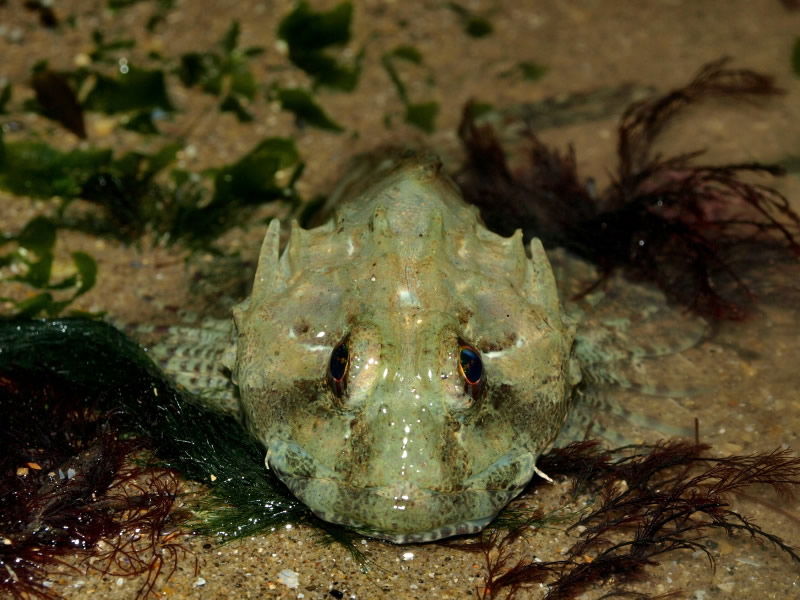
This is a long-spined sea scorpion, a fish that will
hop out of its tide pool when the oxygen level in the water gets too
low. Image by Yashca-commonswiki, via https://en.wikipedia.org/wiki/Taurulus_bubalis#/media/File:Long_Spined_Scorpion_Fish.jpg.
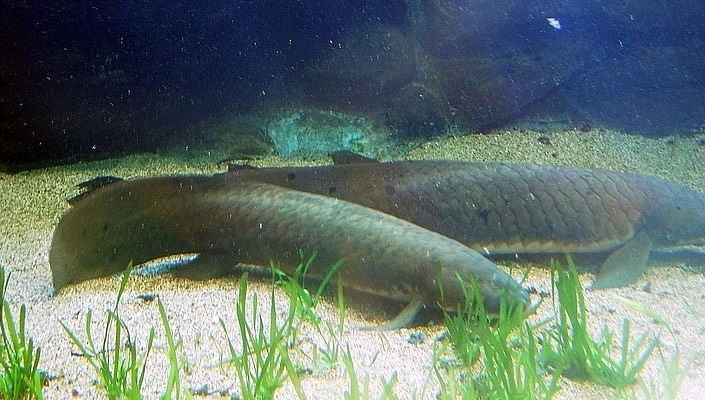
This is a lungfish species native to Australia.
Australian lungfish can exchange oxygen and carbon dioxide using either
gills or lungs. The gills in most species of lungfish, however, are
atrophied. They obtain the oxygen they need through their lungs, so like
aquatic mammals they must reach the surface periodically to obtain air.
The lungfish is thus equipped to survive in poorly oxygenated water and
even to survive if trapped in temporary pools that dry up. Image by
Haplochromis, via https://en.wikipedia.org/wiki/Lungfish#/media/File:Queensland_Lungfish_(Neoceratodus_forsteri).jpg.
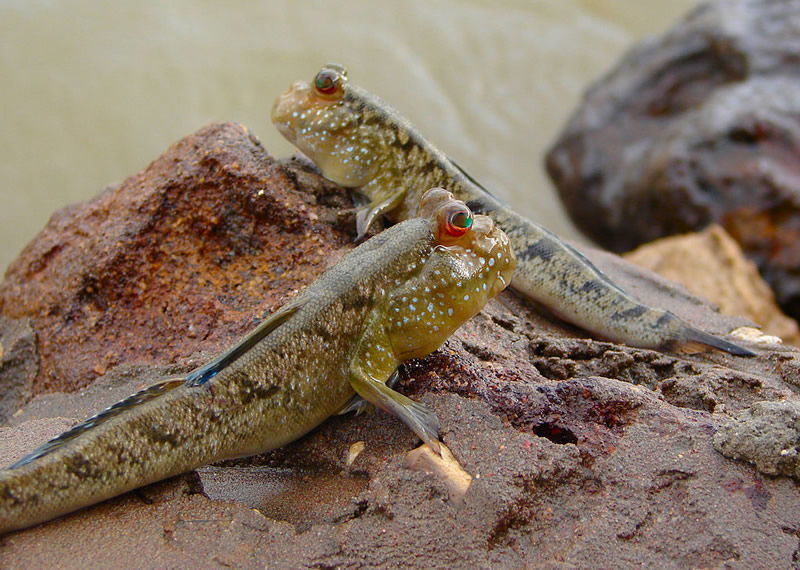
This is one of the many species of mudskipper, a
fish that spends most of its life out of—but close to—water. Mudskippers
can absorb oxygen through their moist skin but are also designed to
keep their gills moist and in contact with a sealed air bubble when out
of the water, allowing them to obtain the oxygen they need while they
scoot about feeding or fighting for their territory on intertidal
mudflats. Image by Uspn, via https://en.wikipedia.org/wiki/Mudskipper#/media/File:GambianMudskippers.jpg.
Amphibious fish, like all fish, have gills throughout their lives. Some, like the leaping blennies, are fairly restricted to specific sorts of habitats and have no lungs; they are neither evolving to colonize new places nor evolving into new kinds of animals. Fish that have gills along with lungs (bimodal breathers) are equipped to endure harsh conditions in which their water’s oxygen content is diminished or when their watering holes disappear altogether.5 Some air-breathing fish—the polypterids, for instance—are not amphibious but fully aquatic, snatching air through a sort of biological snorkel. Well equipped to survive, none of these are changing into any other kind of animal. They are fish. And they are examples of the ways in which God our Creator designed fish when He said, “Let the waters abound with an abundance of living creatures. . . . Be fruitful and multiply, and fill the water in the seas” (Genesis 1:20, 22). These fish are snapshots of diversity within a created kind, not snapshots of evolution or of the way evolution supposedly happened.
Designed for Diversity of Locomotion . . . or Evolving to Walk?
But what if we shift gears to the problem of walking? Amphibious fish generally scoot about on their fins, undulating their tails to push themselves along. They lack not only the bony legs to walk like a tetrapod but also the sturdy attachments of limbs and pelvis to a stable vertebral column needed to fully support their body weight. However, a rare sort of cavefish from Thailand has found a different way to move up in its world.The cavefish Cryptotora thamicola has unique method of locomotion, and without any feet or legs it routinely climbs up waterfalls in its dark world. Surprising anatomical discoveries about how this foot-less fish accomplishes its prodigious feat have been discovered by New Jersey Institute of Technology professors Brooke Flammang and Daphne Soares with the assistance of Apinun Suvarnaraksha of Thailand’s Maejo University. Their revelations about a tetrapod-like pelvic girdle in this walking cavefish are being put forth as an illustration of how ancient fish finally put four on the floor, fought gravity, and moved on up the evolutionary ladder.
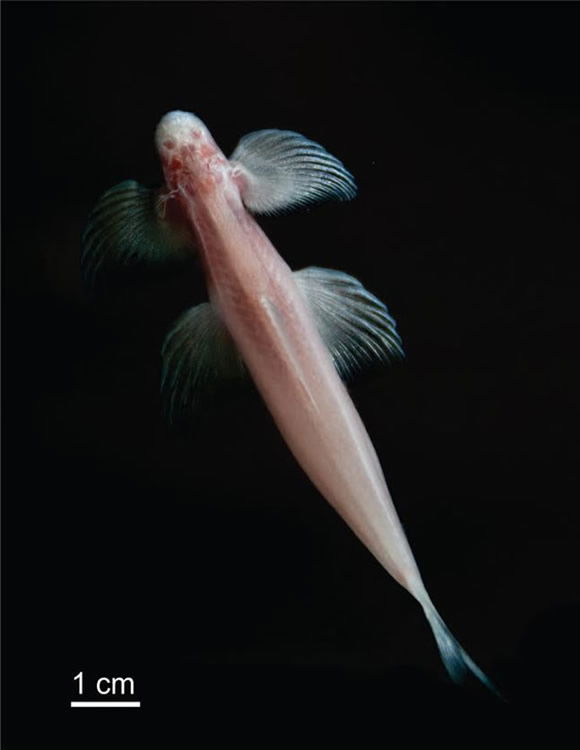
This is Cryptotora thamicola, a species of
blind cave fish found only in the caves of northern Thailand. Its
unusual skeletal anatomy supports its salamander-like method of
shimmying up rock faces against falling water. Image from New Jersey Institute of Technology.
The simultaneous rotation of the fish’s pectoral and pelvic girdles in opposite directions propels its two-inch body without the undulating motion used by other “walking” fish. The attached fins therefore move like a salamander’s legs. The fins diagonal to each other—like front left and rear right—move forward at the same time. (You can see this unique fishy twist in action in the short online videos provided by the researchers.)6
This sort of locomotion has never been described in fish.7 CT scans of Cryptotora reveal its anatomical basis—a stiffened spine firmly attached to the bones supporting the fins. In most fish the pelvic fins are attached to small pelvic bones without any bony attachment to the vertebrae. These only stabilize them enough to avoid rolling over. Cryptotora’s skeleton is different. Its pelvic bones form a large, broad plate. This pelvic girdle is connected to the vertebral column via an enlarged pair of sacral ribs. Furthermore, in contrast to the non-overlapping vertebrae of most fish, its sacral vertebrae are shaped to interlink and overlap, stiffening and stabilizing the spine. “The pelvis and vertebral column of this fish allow it to support its weight against gravity and provide large sites for muscle attachment for walking,” explains Flammang.8 Its bony connections and spinal stability, both reminiscent of the general skeletal principles on which terrestrial locomotion is based, allow it to maneuver using its unusual twisting motion.
It is these bony connections and vertebral shapes that have evolutionists excited. “From an evolutionary perspective, this is a huge finding,” Flammang says. “This is one of the first fish that we have as a living species that acts in a way that we think they must have acted when they evolved from a fluid environment to a terrestrial environment.”9
Of course, Cryptotora is a fish. It is not a transitional form, and no one claims that it is. It is just a fish that has an unusual anatomical variation that allows it to climb the waterfalls in its dark cave home. How might this behavior be helpful to the fish? Perhaps it is exploiting food sources in the flowing water before they become available to other fish in the pool. Its observable anatomy and locomotion are a testament to fish diversity, but they reveal nothing about how fish evolved into terrestrial tetrapods, an unobserved process that evolutionists only suppose happened.
Pelvic-Propelled Evolution?
Cryptotora is not the first fish found with a robust pelvis, just the first live one. Evolutionists have argued that the vertebrate-like limb bones in the lobed fins of the extinct fish Tiktaalik and its unusually robust pelvis show it is the missing link in the fin-to-limb transition. Did Tiktaalik come out of the water ready to hoist its hindquarters and propel itself across land and up the evolutionary tree? Well, fossil evidence is fragmentary, and fossils neither walk nor swim; so in reality researchers can only speculate how that animal moved. But whether nine-foot-long Tiktaalik lifted its rear off the substrate in shallow water, scooted between pools like today’s amphibious fish, did the salamander twist like Cryptotora, or only power paddled in ancient waters, it was still just a fish, not an evolutionary transitional form.When animals adapt to changing or challenging environments, those best suited for the novelties of their world typically survive and reproduce.When animals adapt to changing or challenging environments, those best suited for the novelties of their world typically survive and reproduce. This process of natural selection often produces populations of new varieties and even new species. Land-loving fish and waterfall-climbing fish may be part of God’s original design or the well-adapted products of variation within His created kinds, but such adaptation and natural selection cannot create the genetic information required to evolve completely into new kinds of animals. This should come as no surprise to Bible believers, for the opening chapter of Genesis in God’s Word assures us that God designed animals to reproduce only within their created kinds, creating them fully formed without evolution about 6,000 years ago.
Sonic Hedgehog Speaks Up
But wait! What about the latest genetic evidence? Does it demonstrate our shared heritage with fish? Scientists have known for some time that the Sonic hedgehog (SHH) gene, via its signaling protein by the same name, plays a regulatory role in the embryonic development of the limbs and nervous systems of mammals, birds, and fish. University of Cambridge’s Andrew Gillis has learned more about the role of SHH in cartilaginous fish, specifically the skate. He believes it has evolutionary implications linking our legs to their gills.By inhibiting the Sonic hedgehog gene expression in embryonic skates, Gillis and colleagues found that SHH controls the arrangement of branchial rays on the skate’s gill arches. Branchial rays are finger-like extensions on the gill arches of cartilaginous fish. These rays stiffen the gills. Depending on when Gillis inhibited SHH, the branchial rays would form on the wrong side of the gill arches or form fewer rays but on the correct side of the arches. In mammalian embryos, SHH determines the arrangement of the digits and regulates limb growth. Of course, fingers and toes have nothing to do with gills and branchial rays, so why does Gillis believe his genetic observations reveal something about the unobservable evolution of our legs?
The notion actually goes back to a time long before anyone heard of Sonic hedgehogs or regulatory genes, back to 1878. German evolutionist Karl Gegenbaur noted that branchial rays connected with gills in a way similar to the way bones associated with the fins connect to the fish’s pectoral girdle (“shoulder” bones). He therefore proposed that fins and later terrestrial limbs evolved from branchial rays. No one has taken the idea seriously for a long time, but Gillis indicates his genetics discovery suggests Gegenbaur might be right:
Taken to the extreme, these experiments could be interpreted as evidence that limbs share a genetic programme with gill arches because fins and limbs evolved by transformation of a gill arch in an ancestral vertebrate, as proposed by Gegenbaur. However, it could also be that these structures evolved separately, but re-used the same pre-existing genetic programme. Without fossil evidence this remains a bit of a mystery—there is a gap in the fossil record between species with no fins and then suddenly species with paired fins—so we can't really be sure yet how paired appendages evolved. Either way this is a fascinating discovery, because it provides evidence for a fundamental evolutionary link between branchial rays and limbs.10Though these scientists believe the similar function of Sonic hedgehog in skates and mammals points to “a fundamental evolutionary link” between gills and legs—they really just point to a common Designer. Sonic hedgehog is one of many universal genetic switching mechanisms that our Creator placed in many different kinds of animals. He used similar genetic switches (which scientists have also dubbed hedgehog genes) in other sorts of animals, like fruit flies. Nothing about this demonstrates a shared genetic history or even evolution using a pre-existing genetic program.11 Analogous roles for such genetic switches in different kinds of organisms are exactly the sort of common design we would expect from the fact that skates and people share a common Creator.
Scientific observations—fish designed to diversify into all sorts of ecological niches and the common use of genetic switches in many animals—are consistent with our Creator’s account of His creation provided in the Bible’s first book, Genesis.