Sunday, December 17, 2017

AP Exclusive: Digital police state shackles Chinese minority


KORLA, China (AP) — Nobody knows what happened to the Uighur student after he returned to China from Egypt and was taken away by police.
Not his village neighbors in China’s far west, who haven’t seen him in months. Not his former classmates, who fear Chinese authorities beat him to death.
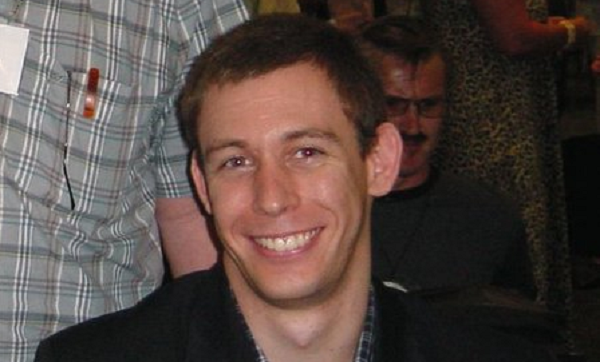
Not his mother, who lives in a two-story house at the far end of a country road, alone behind walls bleached by the desert sun. She opened the door one afternoon for an unexpected visit by Associated Press reporters, who showed her a picture of a handsome young man posing in a park, one arm in the wind.
“Yes, that’s him,” she said as tears began streaming down her face. “This is the first time I’ve heard anything of him in seven months. What happened?”
“Is he dead or alive?”
The student’s friends think he joined the thousands — possibly tens of thousands — of people, rights groups and academics estimate, who have been spirited without trial into secretive detention camps for alleged political crimes that range from having extremist thoughts to merely traveling or studying abroad. The mass disappearances, beginning the past year, are part of a sweeping effort by Chinese authorities to use detentions and data-driven surveillance to impose a digital police state in the region of Xinjiang and over its Uighurs, a 10-million strong, Turkic-speaking Muslim minority that China says has been influenced by Islamic extremism.
Along with the detention camps, unprecedented levels of police blanket Xinjiang’s streets. Cutting-edge digital surveillance systems track where Uighurs go, what they read, who they talk to and what they say. And under an opaque system that treats practically all Uighurs as potential terror suspects, Uighurs who contact family abroad risk questioning or detention.
The campaign has been led by Chen Quanguo, a Chinese Communist Party official, who was promoted in 2016 to head Xinjiang after subduing another restive region — Tibet. Chen vowed to hunt down Uighur separatists blamed for attacks that have left hundreds dead, saying authorities would “bury terrorists in the ocean of the people’s war and make them tremble.”
Through rare interviews with Uighurs who recently left China, a review of government procurement contracts and unreported documents, and a trip through southern Xinjiang, the AP pieced together a picture of Chen’s war that’s ostensibly rooting out terror — but instead instilling fear.
Most of the more than a dozen Uighurs interviewed for this story spoke on condition of anonymity for fear that Chinese authorities would punish them or their family members. The AP is withholding the student’s name and other personal information to protect people who fear government retribution.
Chen and the Xinjiang regional government did not respond to repeated requests for comment. But China’s government describes its Xinjiang security policy as a “strike hard” campaign that’s necessary following a series of attacks in 2013 and 2014, including a mass knifing in a train station that killed 33. A Hotan city propaganda official, Bao Changhui, told the AP: “If we don’t do this, it will be like several years ago — hundreds will die.”
China also says the crackdown is only half the picture. It points to decades of heavy economic investment and cultural assimilation programs and measures like preferential college admissions for Uighurs.
Officials say the security is needed now more than ever because Uighur militants have been fighting alongside Islamic extremists in Syria. But Uighur activists and international human rights groups argue that repressive measures are playing into the hands of the likes of al-Qaida, which has put out Uighur-language recruiting videos condemning Chinese oppression.
“So much hate and desire for revenge are building up,” said Rukiye Turdush, a Uighur activist in Canada. “How does terrorism spread? When people have nowhere to run.”
___
THOUGHT POLICE
The government has referred to its detention program as “vocational training,” but its main purpose appears to be indoctrination. A memo published online by the Xinjiang human resources office described cities, including Korla, beginning “free, completely closed-off, militarized” training sessions in March that last anywhere from 3 months to 2 years.
Uighurs study “Mandarin, law, ethnic unity, de-radicalization, patriotism” and abide by the “five togethers” — live, do drills, study, eat and sleep together.
In a rare state media report about the centers, a provincial newspaper quoted a farmer who said after weeks of studying inside he could spot the telltale signs of religious extremism by how a person dressed or behaved and also profess the Communist Party’s good deeds. An instructor touted their “gentle, attentive” teaching methods and likened the centers to a boarding school dorm.
But in Korla, the institutions appeared more daunting, at least from the outside. The city had three or four well-known centers with several thousand students combined, said a 48-year-old local resident from the Han ethnic majority. One center the AP visited was, in fact, labeled a jail. Another was downtown on a street sealed off by rifle-toting police. A third center, the local Han resident said, was situated on a nearby military base.
While forced indoctrination has been reported throughout Xinjiang, its reach has been felt far beyond China’s borders.
In April, calls began trickling into a Uighur teacher’s academy in Egypt, vague but insistent. Uighur parents from a few towns were pleading with their sons and daughters to return to China, but they wouldn’t say why.
“The parents kept calling, crying on the phone,” the teacher said.
Chinese authorities had extended the scope of the program to Uighur students abroad. And Egypt, once a sanctuary for Uighurs to study Islam, began deporting scores of Uighurs to China.
Sitting in a restaurant outside Istanbul where many students had fled, four recounted days of panic as they hid from Egyptian and Chinese authorities. One jumped out a window running from police. Another slept in a car for a week. Many hid with Egyptian friends.
“We were mice, and the police were cats,” said a student from Urumqi, Xinjiang’s regional capital.
All who returned were intensely grilled about what they did in Egypt and viewed as potential terror suspects, the students said. Many were believed held in the new indoctrination camps, while some were sentenced to longer prison sentences.
The young man from Korla rarely went out in the two years he spent studying Islam in Egypt. He played some soccer — a beloved sport among Uighurs — but wasn’t particularly athletic or popular.
Instead, he kept to himself in an apartment that he kept fastidiously clean, steeped in his studies at the revered Al Azhar University, the 1,000-year-old seat of learning in Sunni Islam. He freely discussed Quranic verses with his Uighur friends but mostly avoided politics, one friend said. He spoke of one day pursuing a Ph.D. in comparative religion.
“He had big dreams,” said the friend who is now hiding in Turkey to avoid being sent to China. “He wanted to be a religious scholar, which he knew was impossible in China, but he also wanted to stay close to his mother in Korla.”
He was fluent in Arabic and but also in Chinese. When they huddled around a smartphone to watch a Taiwanese tear-jerker about a boy separated from his mother, he would be the one weeping first.
When homesickness got to him, he would tell his friends about how his mother doted on him, and about Korla and the big house he grew up in. And when he gets married, God willing, he would say, he’d start a family in that house, too.
“If my wife doesn’t agree, then we don’t marry,” he declared.
He returned to China when he was called back in 2016 and taken away in February, according to three students and a teacher from Cairo. They say they heard from reliable sources in China — but cannot prove — that he died in detention.
___
SHOW OF FORCE
Southern Xinjiang, the vast desert basin from where many of the students came, is one of the most heavily policed places on earth.
Deep in the desert’s southern rim, the oasis town of Hotan is a microcosm of how Chen, the Xinjiang party boss, has combined fearsome optics with invisible policing.
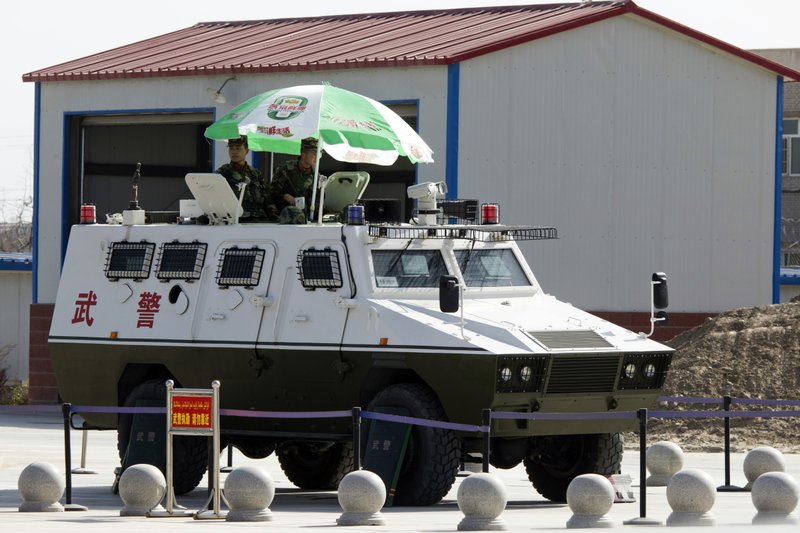
He has ordered police depots with flashing lights and foot patrols be built every 500 meters (yards)— a total of 1,130, according to the Hotan government. The AP saw cavalcades of more than 40 armored vehicles including full personnel carriers rumble down city boulevards. Police checkpoints on every other block stop cars to check identification and smartphones for religious content.
Shopkeepers in the thronging bazaar don mandatory armored vests and helmets to sell hand-pulled noodles, tailored suits and baby clothes.
Xinjiang’s published budget data from January to August shows public security spending this year is on track to increase 50 percent from 2016 to roughly 45 billion yuan ($6.8 billion) after rising 40 percent a year ago. It’s quadrupled since 2009, a watershed year when a Uighur riot broke out in Xinjiang, leaving nearly 200 members of China’s Han ethnic majority dead, and security began to ratchet up.
Adrian Zenz, a researcher at the European School of Culture and Theology who tracks Chinese public security staffing levels based on its recruiting ads, says Xinjiang is now hiring 40 times more police per capita than populous Guangdong Province.
“Xinjiang has very likely exceeded the level of police density seen in East Germany just before its collapse,” Zenz said. “What we’ve seen in the last 12 to 14 months is unprecedented.”
But much of the policing goes unseen.
To enter the Hotan bazaar, shoppers first pass through metal detectors and then place their national identification cards on a reader while having their face scanned.
The facial scanner is made by China Electronics Technology Group (CETC), a state-owned defense contractor that has spearheaded China’s fast-growing field of predictive policing with Xinjiang as its test bed. The AP found 27 CETC bids for Xinjiang government contracts, including one soliciting a facial recognition system for facilities and centers in Hotan Prefecture.
Hours after visiting the Hotan bazaar, AP reporters were stopped outside a hotel by a police officer who said the public security bureau had been remotely tracking the reporters’ movements.
“There are tens of thousands of cameras here,” said the officer, who gave his name as Tushan. “The moment you took your first step in this city, we knew.”
The government’s tracking efforts have extended to vehicles, genes, and even voices. In February, authorities in Xinjiang’s Bayingol prefecture, which includes Korla, required every car to install GPS trackers for real-time monitoring. And since late last year, Xinjiang authorities have required health checks to collect the population’s DNA samples. In May, a regional police official told the AP that Xinjiang had purchased $8.7 million in DNA scanners — enough to analyze several million samples a year.
In one year, Kashgar Prefecture, which has a population of 4 million, has carried out mandatory checks for practically its entire population, said Yang Yanfeng, deputy director of Kashgar’s propaganda department. She characterized the checkups as a public health success story, not a security measure.
“We take comprehensive blood tests for the good of the people, not just record somebody’s height and weight,” Yang said. “We find out health issues in citizens even they didn’t know about.”
A biometric data collection program appears to have been formalized last year under “Document No. 44,” a regional public security directive to “comprehensively collect three-dimensional portraits, voiceprints, DNA and fingerprints.” The document’s full text remains secret, but the AP found at least three contracts referring to the 2016 directive in recent purchase orders for equipment such as microphones and voice analyzers.
Meiya Pico, a security and surveillance company, has won 11 bids in the last six months alone from local Xinjiang jurisdictions. It won a joint bid with a DNA analysis company for 4 million yuan ($600,000) in Kargilik and has sold software that automatically scans smartphones for “terror-related pictures and videos” to Yarkent.
Meiya and CETC declined comment.
___
PRYING EYES
To monitor Xinjiang’s population, China has also turned to a familiar low-tech tactic: recruiting the masses.
When a Uighur businessman from Kashgar completed a six-month journey to flee China and landed in the United States with his family in January, he was initially ecstatic. He tried calling home, something he hadn’t done in months to spare his family unwanted police questioning.
His mother told him his four brothers and his father were in prison because he fled China. She was spared only because she was frail.
Since 2016, local authorities had assigned ten families including theirs to spy on one another in a new system of collective monitoring, and those families had also been punished because he escaped. Members from each were sent to re-education centers for three months, he told the AP.
“It’s worse than prison,” he said. “At least in prison you know what’s happening to you. But there you never know when you get accused. It could be anytime.”
A document obtained by U.S.-based activists and reviewed by the AP show Uighur residents in the Hebei Road West neighborhood in Urumqi, the regional capital, being graded on a 100-point scale. Those of Uighur ethnicity are automatically docked 10 points. Being aged between 15 and 55, praying daily, or having a religious education, all result in 10 point deductions.
In the final columns, each Uighur resident’s score is tabulated and checked “trusted,” ″ordinary,” or “not trusted.” Activists say they anecdotally hear about Uighurs with low scores being sent to indoctrination.
At the neighborhood police office, a woman who gave her surname as Tao confirmed that every community committee in Urumqi, not just Hebei Road West, needed to conduct similar assessments. She said there were no statistics on how many residents had been deemed “not trusted,” nor were there official procedures to deal with them.
“What is happening is every single Uighur is being considered a suspect of not just terrorism but also political disloyalty,” said Maya Wang, a researcher at Human Rights Watch who is studying how Chinese police are using technology to track political dissidents as well as Uighurs.
This month, Xinjiang announced it would require every government employee in the region to move into a Uighur home for a week to teach families about ideology and avoiding extremism.
What pains most, Uighurs abroad say, is the self-imposed barrier of silence that separates them from loved ones, making efforts to say happy birthday or find out whether a relative is detained risky.
When Salih Hudayar, an American Uighur graduate student, last called his 70-something grandfather this summer, he spoke in cryptic but reassuring tones.
“Our phones will not work anymore,” his grandfather said. “So, don’t try calling and don’t worry about us. We’ll be fine as long as you’re all fine.”
He later heard from a cousin in Kyrgyzstan that his grandfather had been sent to re-education.
A Uighur student who moved to Washington following the crackdown this summer said that after his move, his wife, a government worker still in Urumqi, messaged to say the police would show up at her home in 20 minutes. She had to say goodbye: after that she would delete him permanently from her contacts list.
A month later he received calls on WhatsApp from a man who introduced himself as Ekber, a Uighur official from the international cooperation office of the Xinjiang regional public security bureau, who wanted him to work for them in the U.S. — and warned him against saying no.
“If you’re not working for us then you’re working for someone else. That’s not a road you want to take,” he snapped.
A week after that, he couldn’t help himself placing one last call home. His daughter picked up.
“Mom is sick but she doesn’t want me to speak to you. Goodbye,” she said.
___
UNANSWERED QUESTIONS
For the past year, Chen’s war has meant mass detentions, splintered families, lives consumed by uncertainty. It has meant that a mother sometimes can’t get an answer a simple question about her son: is he dead or alive?
A short drive from Korla, beyond peach plantations that stretch for miles, the al-Azhar student’s mother still lives in the big house that he loved. When the AP arrived unannounced, she said she had not received any court notices or reasons about why her son and his father were suddenly taken months earlier. She declined an interview.
“I want to talk, I want to know,” she said through a translator. “But I’m too afraid.”
AP reporters were later detained by police, interrogated for 11 hours, and accused of “illegal reporting” in the area without seeking prior permission from the Korla government.
“The subjects you’re writing about do not promote positive energy,” a local propaganda official explained.
Five villagers said they knew authorities had taken away the young student; one said he was definitely alive, the others weren’t sure.
When asked, local police denied he existed at a

Wednesday, November 29, 2017

Iranian Christian women describe ‘world’s most brutal prison

Maryam Rostampour and Marziyeh Amirizadeh in a 2014 photo (World Watch Monitor)
Two Iranian Christian women who once faced the threat of execution for their faith have described the conditions inside Tehran’s notorious Evin Prison, calling it “the most brutal prison in the world”.
Maryam Rostampour and Marziyeh Amirizadeh, who spent eight months there in 2009/10, now live in the US, where they were granted asylum after their release. They wrote about their experiences in a book, ‘Captive in Iran’, published in 2013.
Twenty-one Christians have been sentenced to long prison terms in Iran over the past six months, and many of them are now in Evin Prison. In a new interview with the UK’s Times newspaper, the two women explain the conditions they are likely to be experiencing.
“One day is like a year,” says 35-year-old Rostampour. “Some days you can’t breathe because you don’t know what’s going to happen to you the next day.”
It has been seven years since their release, but she says: “When people experience living in Evin Prison they will never be the same again. The stress is too much. We can’t be the same people. We can’t be as happy as before. We don’t enjoy activities like normal people because all the time we think of those who are still there.”
Rostampour and Amirizadeh, who is 38, describe how they converted to Christianity at a Christian conference in Turkey in 2005 and then turned their Tehran flat into a “house church” and set about distributing an estimated 20,000 copies of the New Testament.
“When people experience living in Evin Prison they will never be the same again. The stress is too much. We can’t be the same people. We can’t be as happy as before. We don’t enjoy activities like normal people because all the time we think of those who are still there.”
Following their arrest in 2009, they were transferred to a women’s cell in Evin Prison, where they were forced to sleep on the floor in a room with 30-40 other prisoners. They say there was just one small window with no view and that the temperature was sweltering in summer and freezing in winter. The lights were kept on all night, while a television incessantly blasted out state propaganda.
They say they were denied medical treatment because of their faith and that they were seen as “dirty infidels”.
“They treated us like animals,” Amirizadeh says.
Amnesty International has criticised Iran for its “cruel” denial of medical care in its prisons, referencing the case of another Christian woman, Maryam Naghash Zargaran, who was released from Evin Prison in August after four years there.
Zargaran had undertaken two hunger strikes to protest against being denied access to the medical treatment she required for long-standing health issues. She was allowed to leave prison temporarily to receive treatment, but each time forced to return before it could be completed. She then had her sentence extended by six weeks to make up for the time she had spent outside prison.

Forced confessions

Rostampour and Amirizadeh also spent 40 days in an interrogation building, where they were asked repeatedly to deny their Christian faith, while interrogators demanded the names of the people who had attended their “house church” and asked them to sign forced confessions.
“If you don’t give us the information we need, we’ll beat you till you vomit blood,” they were told.
Such demands for confessions are often reported by Christians in Iranian prisons, such as in the cases of Mohammed Ali Torabi, 39, who was recently released on bail, and Abdol-Ali Pourmand, who remains in prison in Ahvaz, capital of Iran’s western Khuzestan province.
“If a prisoner’s case got attention, they stopped torturing or raping them because they knew the world was watching. We heard of many cases of prisoners who had no voice outside, and many things happened to them.”
Rostampour and Amirizadeh say their interrogators often cited the examples of well-known Christian pastors who had been hanged.
“We can do anything to you and nobody can stop us,” they were told. “Here we are the law and we can do whatever we want.”
The women say the international attention given to their case helped secure their release and also helped them survive their time in jail.
“If a prisoner’s case got attention, they stopped torturing or raping them because they knew the world was watching,” Amirizadeh says. “We heard of many cases of prisoners who had no voice outside, and many things happened to them.”
Following their release, the two women say they felt they “could not live in Iran any more as Christians”, having been warned by their interrogators they may one day suffer an “accident”.
But even so, Rostampour says: “Iran is our country. It’s our home. We miss the streets and the mountains. We have family and friends there. We’re heartbroken for our country and pray that one day our country can be free from this brutal regime

Sunday, November 12, 2017

BRITISH LABOR PARTY ANTI-SEMITISM and ANIT-SEMITIC POSTERS IN CALIFORNIA from David Hocking (www.davidhocking.org)

BRITISH LABOR PARTY ANTI-SEMITISM

Three prominent British Jewish authors said in an open letter that they are concerned that anti Zionism in the country's Labor Party is now "closer to anti-Semitism.

Howard Jacobson, Simon Sebag Montefiore and Simon Schama said in the open letter in The Times that they are "troubled by the tone and direction of debate about Israel and Zionism within the Labor Party."

The letter said "We are alarmed that during the past few years, constructive criticism of Israeli governments has morphed into something closer to anti-Semitism under the cloak of so-called anti-Zionism. We do not object to fair criticism of Israel governments, but this has grown to be indistinguishable from a demonization of Zionism itself."

The authors noted that accusations of international Jewish conspiracy and Jewish control of the media have once again become ubiquitous, as have creating parallels between the Jewish state and Nazism.

"Such themes and language have become widespread in Jeremy Corbyn's Labor Party. So far the Labor leadership's reaction has been derisory.  It is not enough to denounce all racisms in general when this specific strain rages unchecked," the authors wrote.

They also noted the suffering of the Palestinian Arabs. "We do not forget nor deny that the Palestinian people have an equally legitimate, ancient history and culture in Palestine nor that they have suffered wrongs that must be healed. We hope that a Palestinian state will exist peacefully alongside Israel," they wrote.

Jacobson won the Mann Booker Prize 2010 for "The Finkler Question." Schama recently published "Belonging," the second part of his trilogy "The Story of the Jews," and Montefiore is the author of "Jerusalem: The Biography."


ANIT-SEMITIC POSTERS IN CALIFORNIA

Northern California synagogue vandalized with posters portraying Jews as rapists, using anti-Semitic slurs, and praising Hitler's 'warning'.

Anti-Semitic posters portraying Jews as serial rapists and praising white supremacist mass-murderer Dylann Roof were pasted to a synagogue in suburban Sacramento, California over the weekend.

Members of congregation Or Rishon on discovered about 10 to 15 of the hate posters stuck to the building, The Sacramento Bee reported. They were placed on the building overnight between Friday and Saturday.

The posters included one seemingly justifying the June 2015 mass-shooting committed by white supremacist Dylann Roof at a predominantly black church in South Carolina, killing nine.  Other posters featured anti-Semitic caricatures.

One poster portrayed Jews as rapists, showing an image of disgraced former Hollywood producer Harvey Weinstein and a man with side-locks sexually assaulting a non-Jewish woman. The poster also appears to praise Adolf Hitler and other prominent anti-Semites, exhorting the public to heed their "warnings" against Jews. The poster also used an anti-Semitic epithet.

"Yikes! Kikes! Hitler, Rockwell, and Pierce warned you about sleazy Hollywood kikes," the poster said, referencing white supremacists William Luther Pierce and George Lincoln Rockwell.

The incident was reported to the Sacramento Sheriff's Department and the FBI, according to the report.

Security camera footage is being reviewed, the temple's president, Kimberly Olker, told local NBC affiliate KCRA, Channel 3 news.

Rabbi Alan Rabishaw told the Bee that he has received messages of support from community leaders and leaders of the Muslim community. He said it is the first time the temple, which serves about 275 families, has been targeted.

He told the newspaper the temple will not change how it operates in response to the attack.

"They're not in control, not even a little bit. We're not hiding, we're not afraid. We just do what we do with joy and peace in our hearts," he said.

Sunday, October 29, 2017

HAMAS TO TRUMP: WE WANT TO WIPE OUT ISRAEL, NOT RECOGNIZE IT! By David Rosenber HAMAS IGNORES ISRAEL, SENDS DELEGATION TO IRAN by Elad Benari Arutz Sheva News WILL THE US CONGRESS RISE TO THE CHALLENGE OF DEALING WITH IRAN? By Yoram Ettinger

HAMAS TO TRUMP: WE WANT TO WIPE OUT ISRAEL, NOT RECOGNIZE IT! 
By David Rosenberg

Terror group denounces Trump Administration demand that Hamas disarm, recognize Israel. 'No one can disarm Hamas.'

A senior Hamas leader denounced demands by the Trump Administration that the terror group be disarmed, and that its leadership must recognize the State of Israel following the reconciliation agreement between the Palestinian Authority and Hamas.

Last week, Hamas and the Palestine Liberation Organization-led Palestinian Authority inked a "final" reconciliation agreement, forming a united government for the first time in a decade.

Following the signing of the agreement, Israel announced it would not negotiate with the Hamas-PLO unity government.

On Wednesday, President Trump's special envoy to the Middle East Jason Greenblatt demanded that in light of Hamas' new position in the PA, the terror group must disarm, recognize Israel, and adhere to all other agreements and commitments the PA has made over the past quarter century.

"All parties agree that it is essential that the Palestinian Authority be able to assume full, genuine, and unhindered civil and security responsibilities in Gaza and that we work together to improve the humanitarian situation for Palestinians living there," Greenblatt said.

"The United States reiterates the importance of adherence to the Quartet principles: any Palestinian government must unambiguously and explicitly commit to nonviolence, recognize the State of Israel, accept previous agreements and obligations between the parties - including to disarm terrorists - and commit to peaceful negotiations.

"If Hamas is to play any role in a Palestinian government, it must accept these basic requirements."

Hamas on Thursday blasted Greenblatt's statement, accusing the United States of "blatantly interfering in matters that belong only to the Palestinian people. We have the right to choose a government that is suitable for the Palestinians."

A spokesman for the terror group added that "Jason Greenblatt's statement contradicts previous statements that supported the internal Palestinian reconciliation, and was put out under pressure from Israeli Prime Minister Binyamin Netanyahu and his extremist government."

At a rally in the Gaza Strip, Hamas' second highest ranking military leader, Yahya Sinwar, not only denounced Greenblatt and the Trump Administration's demand, but declared that Hamas still has every intention of annihilating the State of Israel.

"Gone is the time in which Hamas discussed recognition of Israel. The discussion now is about when we will wipe out Israel," said Sinwar.

"No one has the ability to extract from us recognition of the occupation."

"No one will disarm us. No one can disarm Hamas."

Prior to the reconciliation agreement between the PA and Hamas, President Trump had pushed for a Middle East peace summit intended to reboot final status negotiations between Israel and the PA, which have been frozen since 2014.


HAMAS IGNORES ISRAEL, SENDS DELEGATION TO IRAN 
by Elad Benari Arutz Sheva News

High-ranking Hamas delegation, headed by Salah al-Aruri, visits Iran to discuss reconciliation with Fatah.

A high-ranking Hamas delegation began a visit to Iran to inform its backers in Tehran about reconciliation efforts with rival faction Fatah, a Hamas official said, according to AFP.

The group was led by recently appointed deputy Hamas chief Salah al-Aruri, who is accused of organizing multiple deadly attacks against Israelis. The group will meet senior Iranian officials over the next several days, the representative said on condition of anonymity.

Hamas and Fatah agreed a landmark deal to end a decade-long split and seek to form a unity government along with other parties.

By meeting Iranian officials in Tehran, Hamas blatantly ignores Israel's demand that it cut off ties with Tehran or Israel will not recognize any unity Palestinian government.

Hamas has already rejected Israel's demand and accused the "Zionist regime" of intervening in internal Palestinian affairs.

Hamas and Iran had been at odds over the uprising against Syrian President Bashar Al-Assad. As a result of Hamas's refusal to support Assad in the uprising, an angry Iran reportedly stopped supplying the terror group with weapons.

This past summer, however, Hamas leader Ismail Haniyeh thanked Iran for its "unlimited" support for the Al-Qassam Brigades and its contribution to the development of Hamas's military capabilities, an indication that the rift was over.
 

WILL THE US CONGRESS RISE TO THE CHALLENGE OF DEALING WITH IRAN? 
By Yoram Ettinger

President Trump's refusal to recertify that Iran's Ayatollahs comply with the July 14, 2015 Iran Nuclear Deal Framework (JCPOA), and that the agreement is in the US national security interest, removed the Ayatollahs' peaceful "screen saver" and laid the ground to expose the Ayatollahs' rogue reality. 

President Trump acted in accordance with the May 22, 2015 bi-partisan Iran Nuclear Agreement Review Act, which was enacted - in defiance of President Obama's opposition - with a veto-override majority.  

On the other hand, the multinational JCPOA - which produced unprecedented tailwind to Iran's revolutionary goals - was engineered by President Obama and Secretary of State Kerry, along with the other permanent members of the UN Security Council (Russia, China, Britain and France), Germany and the European Union.

President Trump's non-certification provides Congress with an opportunity to reclaim its constitutional role as a co-equal and co-determining branch of government, while exposing the inherently rogue Ayatollahs, who have intensified instability, unpredictability, subversion, terrorism and wars in the Persian Gulf, the Arabian Peninsula, the Middle East at-large, Africa, Asia and other parts of the globe.
 
According to the first Article of the US Constitution, as documented in a following paragraph, the power of the US Congress is not limited to legislation and appropriation, but extends to oversight and review of the Executive Branch on the domestic and national security fronts: "Congress shall have power to... provide for the common defense.... Define and punish...offences against the law of nations. 

Declare war....raise and support Armies.... Provide and maintain a Navy. Make...regulations of the land and naval forces.... Suppress insurrections and repel invasions...."

Moreover, the second Article of the US Constitution provides the President with the power to commit the US to treaties with foreign entities - such as the JCPOA - but only with the advice and consent (ratification) of two thirds of the Senate. In 2017, the US Senate can reclaim this power which was dismissed, in 2015, by President Obama and conceded by Congress.

Congress demonstrated its posture as the world's most powerful legislature, and its co-equal role in the shaping of the US national security policy, during many critical junctions in recent US history.  

For example, the Senate has refused to ratify President Clinton's 1999 Comprehensive Test Ban Treaty; Congress prevented the supply of AWACS (Airborne Warning and Control System) to Iran on the eve of the Ayatollah Khomeini revolution; the Senate Majority Leader, Harry Reid (D-NV), foiled President Obama's attempts to close down the Guantanamo detention camp; Congress authorized the 1991 and 2003 wars against Iraq; Congress terminated the US military involvement in Vietnam, Laos and Cambodia (the Eagleton, Cooper and Church Amendments), Angola (the Clark Amendment) and Nicaragua (the Boland Amendment; Congress overrode President Reagan's veto, bringing down South Africa's white regime; Congress overhauled the US intelligence community (Senator Church's and Congressman Pike's Committees); Congress  - in defiance of President Nixon - forced the USSR/Russia to allow free emigration (the Jackson-Vanik Amendment); etc..

When examining the impact of the JCPOA on the US national security, Congress should assess the dramatic erosion of the US posture of deterrence, as reflected by the surging geo-strategic posture of Russia. Both the Ayatollahs, as well as the pro-US Arab countries - especially Saudi Arabia, which recently concluded critical military transactions with Russia - consider the signing of the 2015 Agreement a reflection of unprecedentedly slackened US strategic reliability.

Congress should scrutinize the Ayatollahs' systematic anti-US conduct since their 1979 toppling of the pro-US Shah, including their annual commemoration of the November 1979 takeover of the US Embassy in Teheran, which is highlighted by the theme of "Death to America."

Congress should investigate the Ayatollahs' school curriculum - the most authentic reflection of their mission and tactics, depicting the US as "the arrogant, idolatrous, modern-day crusader, infidel, oppressor, Great Satan." Grade 12 Iranian students are taught - in "Religion and Life," pages 103 and 104 - that dissimulation and tenuous pacts with "un-Godly governments" - such as the US - are proper, but only until the balance of power shifts in favor of the "believers."  Furthermore, the need for child martyrdom, during the apocalyptic battle against the US, is intensively inculcated in all twelve grades.   

Downplaying the significance of the Ayatollahs' school curriculum - lest it undermine the pursuit of an agreement - would catapult Iran to an imperial position, and possibly usher in the first nuclear war.

While the US has rolled-back its sanctions on Iran, the Ayatollahs have rolled-forward their drive to evict the US from the Gulf and the Arabian Peninsula through subversive, terroristic and military attempts of regime-change in pro-US Arab countries in the Persian Gulf - most notably Saudi Arabia and Bahrain - and beyond.

The mega-financial benefits from the JCOPA have enabled the Ayatollahs to expand their presence in Iraq, Syria and Lebanon, posing a growing threat to the pro-US regime in Jordan, while bolstering their presence in Africa and in Latin America, including Mexico, Cuba, Venezuela, Ecuador, Bolivia and the terror-ridden tri-border region of Brazil, Argentina and Paraguay.

On the nuclear front - while rejecting US demands to allow international inspectors to visit military sites - the Ayatollahs have tightened their ballistic and nuclear collaboration with North Korea, co-developing and test-firing nuclear and ballistic technologies and systems, which may also be purchased. It allows circumvention of the monitoring of nuclear programs in Iran.

In 1978/79, the US energized the Khomeini Revolution, which transformed Iran from "the US policeman in the Gulf" to the US nightmare in the Middle East. In 2017, a determined Congressional oversight, and the resurrection of the US posture of deterrence - not diplomacy - could spare the globe of a most rogue anti-US regime and a potential nuclear war

Tuesday, October 24, 2017

From David Hocking’s newsletter NETANYAHU - SUPPORT OF CHRISTIANS and

 
NETANYAHU - SUPPORT OF CHRISTIANS!
By Israel Today Staff

Further dispelling the myth that Israel is hostile toward it's Christian population, Prime Minister Benjamin Netanyahu welcomed Christian media representatives to Jerusalem.

But he did more than just invite foreign Christians to see how their brothers and sisters in Messiah live in the Holy Land.

Netanyahu openly decried the mistreatment Christians in nearly every other part of the Middle East, and the world's indifference to their suffering.
Said the Prime Minister:

"Christians have been lashed for sipping wine during prayer services, brutally tortured for doing nothing more than practicing their faith. Some world leaders are willing to ignore this oppression and seek to appease Iran, but I am not one of them."

He took particular issue with Iran's treatment of Christians, referencing the imprisonment of pastors and those who dare to convert from Islam to Christianity.

"I think that how a country treats religious minorities is a very good indicator of how it will treat its other citizens and its neighbors," Netanyahu said.

USA PRESIDENT DONALD TRUMP AND THE DEAL WITH IRAN
Israel Prime Minister Benjamin Netanyahu was right in noting that "when Israel and the Arab states agree on something, then you should pay attention."

Netanyahu was so right, that he repeated the phrase several times, to different audiences.

Responding to US President Donald Trump's decision to decertify the Iran nuclear deal under its current, grossly-violated conditions, and to classify the Islamic 

Revolutionary Guard Corps as a terrorist organization, Netanyahu told American media:

"I commend the President for taking a historic and bold decision to avert this danger in time.

"He could have kicked the can down the road. He could have said 'this isn't going to happen on my watch, so I'll just let it go,' but he didn't. He faced up to this danger and I think he gave an opportunity for all of us in the Middle East and beyond to fix this deal. Fix it or nix it. Because it could be very dangerous if it just went through."

Genesis 6:1-4 Who Are the Sons of God? David Hocking (www.davidhocking.org)

https://www.davidhocking.org/playmessage.php?message=20170925

Sunday, October 15, 2017

UNITED STATES TO PULL OUT OF UNESCO AndTHE CELEBRATION OF SUCCOTH (FEAST OF TABERNACLES) by Sara Coughlin

UNITED STATES TO PULL OUT OF UNESCO!
  
The withdrawal was confirmed by U.S. officials speaking on condition of anonymity because they weren't authorized to be publicly named discussing the decision.

It was not clear when the move would be formally announced. The decision comes as the U.N. Educational, Scientific and Cultural Organization is voting to choose a new director this week, in tense balloting overshadowed by the agency's funding troubles and divisions over Palestinian membership.

Many saw the vote to include Palestine as evidence of long-running, ingrained anti-Israel bias within the United Nations, where Israel and its allies are far outnumbered by Arab countries and their supporters. UNESCO is best known for its World Heritage program to protect cultural sites and traditions around the world. The agency also works to improve education for girls in desperately poor countries and in scientific fields, to promote better understanding of the horrors of the Holocaust and to defend media freedom, among other activities.

The Trump Administration has been preparing for a likely withdrawal for months, and a decision was expected before the end of the year, according to U.S. officials. Several diplomats who were to have been posted to the mission this summer were told that their positions were on hold and advised to seek other jobs.

In addition, the Trump Administration's proposed budget for the next fiscal year contains no provision for the possibility that UNESCO funding restrictions might be lifted. The lack of staffing and funding plans for UNESCO by the U.S. have been accompanied by repeated denunciations of UNESCO by senior U.S. officials, including U.S. Ambassador to the United Nations Nikki Haley.

The U.S. pulled out of UNESCO in the 1980s because Washington viewed it as mismanaged and used for political reasons, then rejoined it in 2003.
THE CELEBRATION OF SUCCOTH (FEAST OF TABERNACLES) 
by Sara Coughlin

This Holiday is the joyous follow-Up To Yom Kippur

Sukkot, the weeklong Jewish festival that not only signals the end of the high holidays but holds both historical and seasonal significance, as well.

Rabbi Ari D. Weiss of Cornell Hillel tells Refinery29 that Sukkot is the final harvest festival in the Jewish calendar, with Passover and Shavuot preceding it. It's specifically associated with the end of the fruit harvest in Israel, which was historically considered a period of bounty. So, Sukkot was traditionally a chance for Jewish people to pause and celebrate the newfound wealth that comes with the harvest, but with an understanding that wealth can be temporary.

Rabbi Weiss compares the spirit of Sukkot to that of Thanksgiving: "The underlying message is to give thanks, but also to recognize that it's not all ours. It's not really our work that creates the wealth - it's really greater things that do that, whether it's nature or God."

It's from that desire to show gratitude - and to demonstrate the impermanence of wealth - that it's customary to build a temporary structure known as a sukkah ahead of or during Sukkot. "When we're the wealthiest, we actually uproot ourselves and go into temporary dwellings for seven days to celebrate," Rabbi Weiss explains. He adds that a sukkah is also a symbolic nod to the shelters in which the Israelites lived while wandering the desert for 40 years. This moment in Jewish history is a point of focus throughout Sukkot.

In addition to spending time in a sukkah, people will use the week of Sukkot (which now has concluded) to enjoy fun outings with their families. Observant Jews will also attend special synagogue services, which incorporate seasonal imagery. Known as the four species, four types of plants are blessed and used during Sukkot prayers: a citron, a palm leaf, willow branches, and myrtle branches.

Two holidays arrive at the conclusion of Sukkot - Shemini Atzeret and Simchat Torah. Rabbi Weiss says that these are celebrated as one in Israel, but, depending on the denomination of Judaism one follows, they are viewed as separate occasions elsewhere. Where the former marks the official end of the high holidays, the latter is more of an opportunity to celebrate the Torah.

As this festival draws to a close, people return their attention to the year ahead, only now with the reminder that simplicity and gratitude should go hand-in-hand with moments of joy.

Biblical information is found in Leviticus 23 - a listing of "holy convocations" or "feasts of the LORD" - May the LORD God of Israel open the eyes and hearts of His people to the coming of the Jewish Messiah! To God be the glory!

Sunday, October 1, 2017

From David Hocking (davidhocking.org)

MESSIAH AND THE FALL FESTIVALS
LEVITICUS 23 : 23-44

Yeshua said in Luke 24:44:
"These are the words which I spake unto you, while I was yet with you, that all things must be fulfilled, which were written in the law of Moses, and in the prophets, and in the psalms, concerning ME!"

There are four major celebrations in the spring and three in the fall that speak of our Messiah and His work in bringing salvation and hope to both Jew and Gentile.

These celebrations according to Leviticus 23:2 are called "feasts of the LORD (Yahweh)." And He refers to them as "My feasts." Without the Lord, these celebrations are stripped of their meaning and impact and become mere tradition without the power. Paul wrote in Romans 1:16: "I am not ashamed of the gospel of Messiah, for it is the power of God unto salvation, to the Jew first, and also to the Greek (Hellenist)."

These celebrations are said to be "holy convocations" and are to be honored as the Shabat (Sabbath Day) in that no manual labor is to be done - they are to be set aside for the worship of the Lord, and the celebration of His Messiah!

These fall festivals occur in the 7th month of the Jewish calendar; the Shabat occurs on the 7th day of the week; The sabbatical year is the 7th year, and the Year of Jubilee is celebrated after seven sabbatical years; Shavuot (Pentecost) comes seven weeks after Firstfruits and Sukkot (Tabernacles) continues for seven days as does the Feast of Unleavened Bread in the Spring. Obviously, the number "seven" is highly significant, a religious number, emphasizing the celebration of God's character and the worship of Him alone!

THREE THINGS ABOUT OUR COMING MESSIAH:

1. HIS RETURN FROM HEAVEN
Rosh Hashanah (Feast of Trumpets) - the blowing of the Shofar, a carved ram's horn, not a cow's horn (avoids any connection with the worship of the golden calf); it must be carved, not painted (inappropriate when calling us to repentance, a major theme of this celebration). It must be bent or curved, a reminder of our need of brokenness, humility, and contrition of heart - Psalm 51:17

The ten days following Rosh Hashanah leading up to Yom Kippur (Day of Atonement) are called "high holy days," and it is customary for the Jewish people to dress in white as a sign of humility and the need for cleansing - Isaiah 1:18 is read.

2. HIS REDEMPTION OF ISRAEL
Yom Kippur (Day of Atonement) - celebrated on Tishri 10 - details in Lev. 16 - Luke calls it "the fast."
(1) It PORTRAYS the need of repentance - Lev. 23:27 - "afflict your souls" - Isa. 58
(2) It PICTURES the removal of our sin - Azazel (scapegoat) - Psalm 103:12; John 1:29
(3) It PROPITIATES the wrath of God against sin - mercy-seat - I John 2:2
(4) It POINTS to the need of a High Priest -Heb. 2:7; 3:1; 4:14; 7:23-28; 8:1; 9:7, 11-12; 10:11-14, 21

3. HIS REIGN OVER ALL THE WHOLE EARTH
Sukkot (Feast of Tabernacles) - Tishri 15-22 Also called "the feast of ingathering" or "the Season of our Rejoicing" - more sacrifices than any other feast, expressing our thanksgiving to God (70 bulls, 14 rams, 98 lambs = 182 animals) "great day of the feast" - Hoshana Rabbah - the great Hosanna they circled the altar seven times, poured water out of the vessels of the temple, reminding them of the water that came out of the rock in the wilderness - I Cor. 10:4 - "that Rock was Messiah" - the "living water" represents the presence and power of the Holy Spirit.

Monday, September 25, 2017

THE IMPORTANCE OF US PRESIDENT DONALD TRUMP'S VISIT TO THE WAILING WALL! & WILL PRESIDENT TRUMP'S VISIT TO ISRAEL HAVE ANY AFFECT UPON THE PEACE PROCESS?from David Hocking www.davidhocking.org

THE IMPORTANCE OF US PRESIDENT DONALD TRUMP'S VISIT TO THE WAILING WALL!
When US President Donald Trump visited the Western Wall sporting a kippa (yarmulka), it was a clear affirmation that the site is as the Jews say - Judaism's holiest shrine.
And, as Prime Minister Benjamin Netanyahu subsequently pointed out, that was a clear repudiation of the position recently taken by the United Nations.
During a Knesset session marking the 50th anniversary of Israel's liberation of the eastern side of Jerusalem, including the Western Wall, Netanyahu stated:
Trump's visit "destroyed UNESCO's propaganda and lies."
Netanyahu further insisted that with the city now reunited under Jewish rule, it will never again be divided.
"The Temple Mount and the Western Wall will forever remain under Israeli sovereignty," said the Israeli leader.
What that means for Trump's new Mideast peace push is yet to be seen.
Until now, the Palestinian leadership has categorically refused to accept any agreement that doesn't include Israel's surrender of eastern Jerusalem and the Temple Mount.
Will the "Trump Effect" be enough to make the Palestinians back down?

WILL PRESIDENT TRUMP'S VISIT TO ISRAEL HAVE ANY AFFECT UPON THE PEACE PROCESS?
President Trump landed in Israel this past week, and immediately made history.
Remember when one of Barack Obama's first trips was to the Middle East, to give that ridiculous speech about Islam in Cairo?
Do you also remember how he very conspicuously REFUSED to visit Israel during that same trip?
Well, Trump did the opposite.
He made a point of including Israel in his first trip abroad. In fact, he is the first US President to do so.
Not only that, Trump is in Israel as we celebrate the 50th anniversary of the liberation of Jerusalem from Arab forces.
With a man as calculating as Trump, that's no coincidence!

Tuesday, September 19, 2017

What “Black and White” Twins Teach Us About Supposed “Race” by Ken Ham on September 18, 2017 Answersingenesis.org

What “Black and White” Twins Teach Us About Supposed “Race”

by Ken Ham on 
       
Several years ago I wrote an article for our Answers magazine titled “It’s Not Just Black & White.” This article looked at several examples of what are referred to as “black and white” twins—fraternal twins where one is dark skinned with black hair and the other is light skinned with fair hair. Actually, they both have the same skin color (mainly from the pigment melanin) but different shades (tones) of that color. Well, one of these sets of twins is back in the news.
The Biggs twins, Millie and Marcia, are in the news again because they are entering middle school in Birmingham, England. Their mother, who is light skinned (their father is dark skinned), had to explain to school staff that the girls are indeed twins. Reportedly, “some of their teachers were shocked, and strangers are often baffled when they find out the girls are related, much less twins.” Their mother comments,
I’d be picking them up after school, and the other parents would stop me and say: ‘Are they your daughters?’ . . . When I told that them that they were twins, they would always be stunned. I notice a lot of people doing double-takes.
Why are people so shocked by these twins? Because they’ve been indoctrinated with the idea of supposed “races,” an idea fueled today by evolutionary thinking. How could twins be of two different “races”? The Bible offers an entirely different perspective.

One Race—the Human Race

Because all humans are descended from Adam and Eve, we’re all one race, or “one blood” as the Apostle Paul puts it in Acts 17:26. This is confirmed by observational science—humans are one species, Homo sapiens sapiens, and the supposed “racial” differences only account for .012% of the differences between humans.
The reason for the slight differences, such as skin tone and eye shape, between people groups is primarily because of the event at the Tower of Babel (Genesis 11). This division of languages broke up the human gene pool and isolated groups from one another. Certain genetic variations became prominent in different groups.
And, actually, there’s no such thing as “black and white” people. We’re all brown, just different shades of brown due largely to a pigment called melanin. Some people have a little bit of melanin, which gives them light skin, while others have a lot of melanin, which gives them darker skin.
THERE’S JUST ONE RACE—THE HUMAN RACE.
There’s just one race—the human race. We look different because of what happened at the Tower of Babel.

The Answer to Racism

The answer to racism, which I shared at a racial reconciliation conference in Kansas City, Missouri, last week, is first to understand that all people are one race, one family. Genetically and biblically all humans are one biological race. And all humans are people of color—as I like to say, if you don't have color you have a problem and should visit a doctor!
We’re all one race, and we’re all equal before God. And we all have the same problem of sin and need salvation in Christ. We also all need to judge our behavior against the absolute authority of God's Word. If all people were taught this truth about the origin of people groups, it would certainly help to curb racism and prejudice.
There’s only one solution to racism—a change of heart so people will build their thinking on God’s Word and believe the true history of the world. Racism, as well as other social issues such as gay “marriage,” transgenderism, and abortion, are all moral issues that are symptoms of a foundational issue—rejection of God’s Word. America’s racism issues will not be solved until hearts and minds are committed to the true history in God’s Word and the salvation message.
I recently wrote a guest column on this topic, published in our local paper the Cincinnati Enquirer and available online. I encourage you to read and share with others to help fight racism. You can view the article on the Cincinnati.com website.
Thanks for stopping by and thanks for praying,
Ken

Man Awakens After 12 Years in a “Vegetative State,” Says “I Was Aware of Everything”

  Man Awakens After 12 Years in a “Vegetative State,” Says “I Was Aware of Everything” National   |   Sarah Zagorski   |   Jan 12, 2015   | ...